Sleeping With ASMR

I would think that on the days I come in from work so tired I’m amazed I made the journey that the night time would be punctuated only by snores. In practice the experience is a lot more staccato than that. Sometimes the effect is exactly as expected and I hit the pillow with eyes closed and rend the night time with loud snorts and squeakings. Not unusually though I can lie there reading into the early hours or just lie there…

For this reason, I started some years ago now looking into restful material to act as a distraction and discovered that I rather liked ASMR videos. I’m still reviewing them all this time later. Sometimes I spend my time listening to the Procrastination Pen playlist, sometimes to other material. But I reason that if I review ASMR material each week then at least the ASMR fans get some feedback. If I compile a playlist then at least the insomniacs have some distracting material. At least if I write something then the disgruntled have something to criticise which might even make them feel better. (I’m not adverse to a bit of criticising myself).

I did say I’d be on the lookout for material that was not on YouTube and that was advert free. In 2026 that is quite a big ask. It would seem that most people have worked out how to monetise and are squeezing that lemon till the pips gasp their last.

Occasionally I find people of a religious affiliation who produce material due to some spiritual conviction. I recognise though that some readers are not keen to hear from a Christian, Muslim or Buddhist.

Some people produce material on the assumption that if people listen to the free stuff, then they might pay handsomely for the other stuff they produce which is not free.

Some people seem morally disposed to share their message with others and are not hounding a pay cheque. I am grateful for all such people (and no doubt others who have reasons I have not listed here).

I have been listening off and on to a podcast over some months now which is produced in order to spread a message of happiness and not just that but backs it up with scientific findings. It is not hugely ASMRy but you might like the material as a different distraction (to the Procrastination Pen) playlist. It is “The Happiness Lab Podcast” with Dr. Laurie Santos. It often has some very surprising findings for example a recent episode that tells us winning the lottery is likely to be very bad for you: https://www.drlauriesantos.com/happiness-lab-with-dr-laurie-santos-podcast/episodes/winning-lottery-ruin-life.

Having finished my non-YouTube material, let’s look at this week’s Calm material.

https://www.calm.com/app/player/wicRCqVcjB

Daily Jay

Gossip

NARRATOR

Jay Shetty

I am reviewing whether I will continue with Calm, there are so many alternative offerings out there. It’s not likely to be an immediate change. However, do not be surprised if the Calm recommendations ultimately dry up.

I did find today that it is possible to share free links to Calm but the terms and conditions do seem to indicate it is designed for a Calm subscriber (me) to share with the odd friend. Not for them to take a free link and post it on their blog for everyone to use. It sounds like if I did that it might quickly invalidate my subscription. So, I am not going to try it.

This week for the professional ASMR artist I thought that I would try the medical offering from the channel that I reviewed only recently. You might remember that I tried Italian ASMR because I am trying, and failing, to learn Italian. I found that the video was not in Italian. So I failed to stick to the blog theme and failed in the purpose of the diversion.

The same artist I notice has this one:

ASMR Italian Nurse Checks On You 🇮🇹🩺 Medical Roleplay & Personal Attention

It is a bit of a fudge in that I have been trying to review videos which are older as these seem to fall out of favour on YouTube. Most people, seemingly wanting a proper bang with their bang up to date. This one, however, is very, very recent so I am, yet again, diverting from the target.

The channel of course is AppleWhispers ASMR, this has 5.33k subscribers from only eight videos which seems to me properly exceptional. This ASMR artist must have something to be getting that kind of loyalty already.

We’ve previously detailed the notes on the channel so I wont rehash things, however, as expected, there are notes associated with the video itself:

“42,323 views 28 Aug 2026 #asmr #sleep #relax

Your Italian nurse is here to check on you and make sure you’re doing okay. 🇮🇹🩺🤍

In today’s relaxing ASMR medical roleplay, I’ll gently check your condition, take your vital signs and give you plenty of close-up personal attention while you rest.

Just get comfortable and let me take care of you for a little while.

You’ll experience gentle medical checks, soft whispers, close-up attention, soothing hand movements and relaxing examination sounds, all designed to help you switch off, feel cared for and hopefully fall asleep. 🌙

Triggers include:

🩺 Medical examination

❤️ Vital signs check

👀 Close-up visual examination

🤍 Personal attention

👐 Gentle hand movements

💤 Whispering & relaxing medical sounds

I hope your Italian nurse can make you feel a little more relaxed tonight.

Now just rest… I’ll take care of everything. 🤍

—————————

🍎 Welcome to AppleWhispers ASMR!

Hi, I’m Elena! 🤍

I’m so happy you’re here.

My goal is to help you relax, unwind and fall asleep through gentle whispers, personal attention and immersive ASMR roleplays.

If you enjoy my videos, don’t forget to like, subscribe and turn on notifications so you won’t miss future uploads!

🌙 Sweet dreams!

━━━━━━━━━━━━━━

🇮🇹 Looking for ASMR in Italian?

Visit my Italian channel:

   / @appletinglesasmr 

━━━━━━━━━━━━━━

💌 Business Inquiries

appletingles95@gmail.com

🎥 Personalized ASMR Videos

If you’d like to request a custom ASMR video, feel free to contact me via email.

━━━━━━━━━━━━━━

❤️ Support the Channel

If you’d like to support my work, you can leave a donation here:

https://www.paypal.me/AppleTingles

Every contribution helps me create more relaxing content for you. Thank you so much! 🤍

━━━━━━━━━━━━━━

📱 Follow me

Italian ASMR :    / @appletinglesasmr 

━━━━━━━━━━━━━━

🎧 For relaxation purposes only.

Please do not listen while driving or operating machinery.

#asmr #relax #sleep”

These are the normal (for a professional ASMR artist) level of ludicrously long. For a start who comes to YouTube to read the video notes. The majority of professional ASMR artists seem to double as ghost writers for a re-write of war and peace. Mostly I set about the notes with a hatchet in my blog or it would all get rather tiresome. (Perhaps it does anyway).

There are comments. Comments seem to be allowed by all the professional ASMR artists and, mostly, they seem to be describing how close to a deity the listeners feel the ASMR artist is. So here. Not the usual level of thousands of comments. However, a brief spin through those that there are indicates that AppleWhispersASMR is up there with JC and he who could move mountains.

The video is very slightly under twenty-seven minutes long and so an appreciable enough length in comparison to some that I have reviewed. It starts without music and we get the immediate impression that breathy is going to feature. The accent is enchanting and the level of the voice more or less perfect. This is not a whispered presentation. The enunciation reminds me of the French video I reviewed a little while ago. The clicks and clucks that professional ASMR artists produce (presumably because they act as a “trigger” for someone) here seem to occur naturally as a result of the way the words are pronounced. For those who like the odd mouth click this must be a very satisfying experience. For me I am about the voice, the normal spoken voice, and this is a great one. It is calm and well-paced. It is not loud and there are various pauses rather than the gabbling-on that some presenters seem to focus on.

There is the odd clothing related noise due to the artist being in motion quite a lot during the video. I did not find it distracting, but if you are using this for sleep there is absolutely no need to be watching it. The sound is good enough I find.

There are sounds which purport to be bed linens being moved (not excessively loud). There is the odd clunk (apparently of equipment being moved). In a similar way there is the odd click, rattling sound, fizzing sound, associated liquid noises, the occasional phrase in Italian thrown in for good measure. (I think I really need to review some of this artist’s Italian Language output – note to self). There are glove-related noises (not my favourite). There are sounds like hands being moved over a surface (these are off camera so who knows).

There is some whispered content (the normal refuge for a professional ASMR artist). There are sounds of gloved fingers being run through hair (I believe some people watch entire videos of that kind of thing but it happens only briefly here).  There are noises like items being removed from a large paper bag (not incredibly loud, but loud enough).

There’s the odd tap from a reflex hammer being employed (quite quiet).

I did find myself nodding to it at intervals so I would imagine that a lot of listeners would find it an effective sleep aid.

Because I was recently reviewing some wood carving videos, of course I receive recommendations of more wood carving videos from the same artist. I am not given to review wood carving videos. I rather think I am supposed to be reviewing medical-themed videos. However, I noticed a playlist. I rather liked what I saw. So this week I am going to segue into wood carving (again) purely because I enjoyed the content I found on this channel previously.

The playlist is this one:

However, I am going to start with the first video rather than do the whole thing. We can come back on a future occasion and take a look at another one.

There are seventeen videos in this playlist and none of them seem to be particularly long, save the ultimate one. So, this will not take long. The playlist is “The Great Wave (making the woodblock print)” and the first video is:

The Great Wave – Part 1

Logically enough I suppose.

The channel, of course is David Bull, I detailed a great deal about this channel in a previous post so I will not go mad this time. Suffice to say that it has 192k subscribers, one hundred and forty-seven videos, seven playlists – not a one is on a medical theme (it may surprise you to understand).

If the quality is like that in my previous review, I can quite imagine that I will be back to review every single video here (if I am spared). The updates seemed to have slowed a little with the last video (to the channel) being posted eight months ago. I can review a lot faster than that, but then I am not slaving over something that takes quite so long to prepare.

The notes associated with the video are: “189,087 views 5 Jan 2015

This set of videos will document the production of the new reproduction of Hokusai’s ‘The Great Wave’ being made by Dave Bull and his Mokuhankan woodblock print workshop in Tokyo, in early 2015.

The print is being made as a ‘reward’ for backers of the Kickstarter project run in the autumn of 2014 by Mokuhankan to gather support for their new shop in Asakusa, Tokyo.

The print will be carved by Dave, proofed by him once the blocks are ready, and then produced by his printing staff.”

How marvellous to have notes that are not the equivalent length of one of my blog articles…

The video is just slightly over nine minutes and so is not going to waylay you for long. I like short videos. I do not like that between every video, YouTube inserts an inane advert of no relevance whatsoever to the quiet unobtrusive material that I was just watching.

I’m not certain if you have ever clicked on one of these things. I can remember I mistakenly clicked on an advert – it was for a revolutionary cooling system just at the time that it was thirty-two degrees outside. I was taken to a website but (fortunately for me) did not order anything. I found out a month later the whole thing was an utter scam and the product was incapable of doing what it purported to do. I am even more lairy of adverts today than I was before then.

Back to the video itself. It starts without music. There is a background hiss, it does not sound like air conditioning. It was a little loud when compared to the professional ASMR video I reviewed just before it. So I thumbed the volume down a little. Once at that level the hiss was muted and the voice sounded much better. The subject (to me) was interesting. The pace was slow; the voice seems calm. However, the video goes outside and it is really very loud. Lots of background voice noises (people chatting). It is not the quietest. At one stage you can hear a child screaming. It’s a shame, the video was well worth reviewing up to this stage.

Just one, video this time.

That’s it on this occasion, more next time.

See you again next week.

The David Bull playlist on the Procrastination Pen is here:

The overall playlist of videos covered so far on the Procrastination Pen is here:

The videos weeded out because over time they are just not as good as the others is in this archive list:

I keep this in case subscribers to the Procrastination Pen have personal favourites that they want to hear.

The playlist of videos requiring age verification is here:

I can’t be bothered to stop my listening to log on, this interrupts the experience. You may not mind this in which case this list is for you.

I hope that you find the playlists restful and I hope you get plenty of sleep.

If you liked this blog article, why not follow this blog.

Until next time.

Photo by Deep.ai

Fifty Special Things – Longthorpe Tower

When: 04-05-2015

Where: Longthorpe Tower

Price: £6 for two adults £4 for a guidebook


Review: Very popular – it was cold the day we went but there were still a number of people there.

Tip: Opening is restricted – limited to weekends and bank holidays – check the English Heritage site before setting out.

This hasn’t been open long, I found it had opened in 2013 by Dr Janina Ramirez (famous historian and TV presenter)

We were determined to go see it because of the well preserved mediaeval artwork. We visited on a bank holiday monday – one of the few that it opens during the year – don’t turn up on a weekday.

We have been National Trust members for a while but haven’t yet stretched to being members of English Heritage as well. If you do a lot of ancient building exploration joining would be worthwhile.

Patience is the order of the day if you want photographs of the walls inside the tower. It was very popular the day we went. I imagine that remains true throughout the year due to the restricted opening times.

Second Floor

The address is Thorpe Road, Peterborough, Cambridgeshire, PE3 6LU. However parking is in St Botolph’s church car park. This is no particular hardship as long as you are reasonably mobile. However bear in mind that access to the tower is up a set of external stairs.

The tower is the only part of the site that is accessible as the rest of it is still in private hands. Whilst I’m sure it’s lovely to live in such a prestige location I’m not certain about lots of visitors traipsing past your door every day.

The tower was apparently originally built by Robert Thorpe who was a lawyer. It was an addition to an earlier house.

The tower is a solar tower – added around 1300 but is unusual in that they were usually added to grand houses – possessed by nobles – rather than someone from the legal profession.

The tower or solar contained Thorpe’s private apartments, the second floor contains Thorpe’s bedroom. Thorpe was a Steward of Peterborough Abbey which at the time owned nearly all the land.

As an official of the cathedral Thorpe would have been a well-respected professional in his day. However he is the mediaeval equivalent of a man made good (from humble origins). Thurstan De Thorpe was still a (villein) serf to the manor at Orton Waterville until 1200 (or thereabouts).

However by 1226 his son William was able to buy the manor at Longthorpe. No one seems to have dug too deeply into how they got their cash…

This site however speculates that with education it was possible to elevate yourself (even in an era when to pass yourself off as gentry was illegal).

The family seems to have loved that habit of naming the son after the father: William begat William who built the manor house and the church whose car park you used on the way in. Originally St Botolphs was on the edge of the village. It was for the use of the manor originally but now is the parish church.

Second William begat Robert (which would be easier only Robert then begat you guessed it – Robert).

First Robert is the one we have to thank for the solar – it is a scaled down version of a similar construction more frequently found in castles. Robert became enriched through services to the nearby abbey. However by 1320 was working directly for Edward II. (He received a knighthood).

Second Robert became a steward to the Abbey like his father and the wealth continued. It was he who commissioned the paintings, which were painted around 1330.

As a defensive building it is sadly lacking (Robert was attacked there in 1327 and held to ransom). It was designed to show off the owner’s wealth and status – this it does rather better.

It is likely that connections with the Abbey allowed Robert access to artisans with significant skills (such as those commissioned for work on the 1st floor). However the skills are somewhat variable as some paintings are better executed than others.

Sadly it wasn’t to be for the Thorpes – although the building remained with the family, the final Thorpe – William – died without children in 1391.

Thereafter it was a second home for a while for John Whittlebury. This family retained the house from 1391 and sold it  to the Fitzwilliam family in 1501.

The Fitzwilliam family retained the house thereafter – the tower alone was gifted to the nation in 1948. This was probably because it required some quite expensive structural work which was taken on by the then Ministry of Works.

It is a great shame that the adjoining buildings can’t be viewed as well. After all that history one would imagine that they are magnificent.

The ground floor is unpainted and historically would have been used for storage. (The painted room is on the first floor). But you can’t get into the ground floor in any case.

The second floor is also unpainted but has some interesting displays including this helmet.

On the day we went (probably for everyone on reflection) we were invited to lift the above helmet to discover how heavy it was.

It is extremely heavy, how a mediaeval knight managed this together with a suit of armour I do not know – they must have been very hardy types.

This is the stone seat of a Garderobe – this is a basic form of mediaeval toilet.

Given it’s on an outside wall and would have been exposed to the elements I couldn’t help wondering why the seat wasn’t wood faced as it must have been very cold in winter.

Apparently a good cure for moths was to hang clothes in the Garderobe as the smell deterred them.

The word wardrobe apparently has its origin in this practice of hanging clothes in a small space.

As you can see mediaeval rooves were not hot on insulation the tile pegs can be clearly seen here. The house might be impressive but it doesn’t seem to have been cosy.

All the windows have been glazed over but historically glass would have been very expensive indeed. Certainly areas like the Garderobe were often left open to the elements in order to dispel the odours.

Rooftop views of adjoining buildings to which sadly there is no access.

The existing access is provided by a timber stairwell up through an enlarged former window. Originally the access would have been through a door (now blocked) to the adjoining hall. Additionally there is no direct access from the first floor to the ground floor storage area – access originally being gained through the adjoining building.

The adjoining hall is Grade I listed like the tower.

The narrow stairwell to the first floor.

It is best to avoid people on the way down – passing on those stairs would be challenging.

I didn’t find the rope of much assistance. Pushing against the wall whilst muttering “steep stairs piggin’ steep stairs” in the end being much more efficacious.

An arrow slit on the main stairwell – now glazed.

How on earth did servants get up and down these stairs whilst carrying things? I’m not clear if Thorpe liked to dine in his chamber but the kitchens were elsewhere in the site so it would have involved some trek if he did.

Small room off the recess in the second floor probably originally a latrine.

The First Floor

And so at last to the first floor, this is what the fuss is all about. After the paintings became unfashionable the walls were whitewashed over (around the time of the reformation). The paintings were thus hidden from view for centuries.

After a period of lease to the Home Guard in World War II the tower became part of a farm again in September 1945. The farmer (Hubert Horrell – a nicely alliterative name that) was prepared for decorating. He discovered sufficient of the pictures to make him believe that the tower was of importance.

He notified the owner (Captain Fitzwilliam) who thankfully recognised the importance of the pictures. He decided to fund an expert examination. He spoke to The Society of Antiquaries of London. Eventually a wall-painting specialist, Edward Clive Rouse was determined to be the man to start releasing the paintings from the layers of whitewash.

It took years – until 1948 – to reveal all of the paintings.

It is now regarded as one of the best preserved wall decorations of a mediaeval domestic building (in England if not in Europe).

Sadly the paintings are much faded now but are said to have been very bright indeed on discovery.

They were painted onto dry plaster using pigments including red/white lead, chalk or vermilion mixed with egg and oil. There is also evidence that some of the paintings were gilded.

Some of the depressed lines were made in the plaster whilst it was still wet.

Some of the detail that was evident at their discovery in 1946 can no longer be seen . Thankfully Mr Rouse was an excellent record keeper creating a small scale watercolour of every painting as he found it.

Potentially I assume this could mean that they could be restored. Something that has been done to great effect in some of the Egyptian tombs I notice.

This first floor room is believed to have been the great chamber for the manor.

It probably had several uses including dining room or reception room. The paintings were therefore for the purpose of impressing guests.

The West Wall

This is the Left hand side of the west wall. The west wall consists of a large alcove with a tiny window offset to the right hand side.

This leaves a large expanse of wall – now painted.

However remember that the paintings date to some-time after the building was erected.

Nonetheless this design seems to indicate that painting the walls was always in the plans. Otherwise why leave this large expanse of wall space and such a small window.

The tower has suffered subsidence in the past which lead to some alterations although it is believed that originally the North wall looked similar in construction.

The above picture shows 4 figures on the arch which are identified as the labours of the months – only 4 can be seen here starting with January at the bottom and moving up to April.

The months have an inscription (where this survives). January is said to be a man warming himself by the fire. February is too destroyed to be certain. March is a man digging. April again is damaged but it is speculated that he may have held flowers. This is in common with depictions at the time of rural people and what they were doing in each of the months.

The only other month that remains is December (the other side of the arch).

Close up of the lower left hand side said to be a pecking bird and the upper part of the door in the South wall that used to lead into the great chamber but is now sealed.

The upper picture is said to be St Anthony. Part of the inscription survives. St Anthony is the figure standing praying – asking how to find salvation. Opposite him is an angel sitting making a basket (working) and an angel behind stood (praying).

Overhead – now largely lost was the head and shoulders of God watching from above. The answer to his question – you can find salvation by praying and working.

The inscription read “do thus and you shall be saved” (apparently SIC FAC ET SALVUS ERIS) apologies to anyone who actually understands Latin.

St Anthony was the patron saint of basket weavers which is perhaps why this was the illustration chosen of work.

Alternatively Peterborough is considered the gateway to the fens and basket weaving has for a long time been considered a Fenland craft.

Two rabbits can just be seen behind Saint Anthony although these are less well done – appearing more like Disney Rabbits than real rabbits.

The border below is quite faded but apparently represents textile. It contained images of a lapwing and owl and a parrot apparently although you may find it difficult to pick those out now.

The two large figures are said to be a teacher and a student with perhaps the teacher wearing a doctor’s cap.

To the left of the teaching scene, on the walls of the recess. From the bottom of this picture: a square niche in the wall, above it a Heraldic Shield, above that a creature (mostly lost) and above that a heraldic banner.

Continuing to the left of the teaching scene, further up the wall on the same side. On the right hand side of this picture can be seen more heraldic banners, to the left a figure (unidentified).

On the West wall the lancet window is small and to the extreme right hand side (North). The window was apparently placed so that painting could be presented on the remainder of the wall. This is an alcove to the right of the window – 2 figures and an inscription which is now hard to make out.

The figure on the left wears a garment with a hood, the figure on the right is said to be a child. The hooded figure is saying to the child “Our Lady will absolve us from sin” (NOTRE DAME NOUS ASOUDRA DE LA PECHE)

This is the Right Hand Side of the West Wall said to be representations of a Bittern and of a Crane. (The Bittern is the uppermost picture). These were apparently not often painted from life but from representations of such creatures found in a bestiary.

The left hand side of the window in the West Wall this is said to be Saint Paul In his right hand a sword in a scabbard.

A close up of the same image.

The East Wall

In the upper part of the wall two figures address one another. The one on the left has been almost completely lost (some of the foot can be seen The figure on the right is complete. He is holding gloves and has a dog standing behind him, however the inscription which would have told us what this meant has now been lost.

Below him is a person in a crown standing behind a wheel. This is called a wheel of five senses and originates with Aristotle but found this form in the 13th century. The rim of the wheel has on it a Monkey, a hawk, a spiders web, a boar and a cockerel – of which the monkey (though partially missing) seems the best done.

These had the following meanings:

Monkey – taste

Hawk – smell

Spider’s web – touch

Boar – hearing

Cockerel – sight

The artist made a mistake with the cockerel and his first attempt can be just seen above the current version.

At one time the wheel would have had inscriptions which indicated what it meant – these are now lost.

It is believed that this means the five senses need to be regulated through reason and restraint.

To the right are two damaged creatures said to be hounds and to the left a damaged creature said to be a squirrel.

It can be seen here that the Boar is not very well done (could easily have been an overweight dog). The remnants of one of the damaged hound pictures can be seen.

Above on the ceiling is a representation apparently of an organ player (a mobile or portative organ with 16 pipes).

Close up on the Spider’s web which could as easily be a dartboard I suppose or given the date more likely an archery target.

Above the doorway can just be seen a very faded set of pictures said to be of the apostles.

This image is in the recess for the current doorway (which was a lancet window). It was enlarged to make space for the current doorway.

This picture appears above a doorway that would have led to a latrine. It is a picture to remind the viewer of mortality and was popular in mediaeval times.

Baased on a 13th Century poem originating probably in France. The legend is that 3 men meet with 3 dead and the 3 dead urge them to repent. The poem may have first been told by Baudoin de Condé a minstrel attached to the court of Marguerite II, Countess of Flanders in the 13th Century.

In this representation the first king is now lost, the second has a red crown which you might be able to see, the third is the one speaking with his finger raised.

The three dead startle the three kings and the kings rebuke them for this. But the dead state that they are the king’s ancestors and question them about why they have not said mass for their souls.

The message is designed to point out how fleeting is the existence of man and hence provide a moral message.

The three next to the king with the upraised finger are now in black but the pigment was lead which has oxidised with time, originally they would have appeared as in white shrouds. The last though is without a shroud – naked – and covered in maggots.

Above the current entrance door there is an aperture cut in the 1940s to expose the remnants of the original lancet window. The current entrance was enlarged in the 17th century and is now back in use. It uses a wooden staircase constructed in the 1940s. The hole which you can see here (when viewed from the correct angle) shows the original construction.

The figure just before the hole is said to be one of the apostles. (The Halo is visible – potentially at one time having been gilded).

To the left of the apostle above is this image of an apostle on the same wall. There is no indication as to which apostle is which. This one appears to be writing I think. Traditionally an apostle writing is generally thought of as St Paul – after his letters to the Corinthians and so on…

Facing the current entrance (I.e. looking towards the east wall) there is a niche just inside the door on the left hand side.

It is of a bearded man teaching three pupils the only discernible word when uncovered in the 1940s was apparently OREILLEZ which may mean “hear me” in old French.

The North Wall

This is the Right Hand Side of the North Wall, uppermost is the second half of the “seven ages of man” the last figure is the easiest to see with a crutch he is decrepitude above him is old age (said to show a man with his life savings).

Above you can see the entire seven ages of man of which a great deal is lost. It starts at the left hand side with an infant; above this is a young boy with a spinning top; above that is adolescence but of which little can be seen.

In the centre top is a youth with a hawk; descending the right hand side is manhood – with a sword; old age – with life savings and decrepitude – with a crutch.

Beneath the 7 ages of man is a depiction of the nativity which has been partly encroached upon. (The window was widened in an attempt to counteract subsidence).

Originally it would have been a small window as for the west wall seen above. However what remains is Mary seated on a chair with Jesus. The missing part would have shown the crib , the ass, an ox (parts of these can still be seen).

The ceiling above the North Wall upper left of this shot is a partial figure believed to be a cymbalum player.

In the other quarter of the vault is the Eagle of St John and beneath that the figure of St David. To the right a Psaltery player.

The South Wall

This is the left hand side of the south wall. Above is a coat of arms said to be that of Edward III.

The border was originally of the Thorpe coat of arms and at one time was gilded – not that you can see it now. Apparently fleur de lys were once visible here – but you need better eyesight than mine to make then out now.

Below the border is an alternating checkerboard pattern said to be painted to look like a hanging cloth. It is likely that this once was behind a high-backed chair that sat against the wall in this position.

This is the right hand side of the South wall uppermost is the arms of Edmund of Woodstock. He was the Earl of Kent and a half-brother of Edward II. He was executed following a planned rebellion against the regent Isabella (after the king was deposed).

The Earl is considered to have been Robert Thorpe’s landlord and so it is likely this is the reason for the inclusion of this coat of arms.

Beneath this something which is much more fun, it is a Bonnacon. You can just see the arm and bow of an archer and the rear of a beast that appears to be ejecting poo in his direction.

Apparently you would be foolish indeed to shoot upon this mythical beast which despatched its victims with flaming ordure expelled from its behind with some force.

The Tower

This is one of the buttresses – showing that the knitting together of the walls is no longer that exact.

Buttress and wall look close to separating here – further evidence of subsidence damage probably.

Here you can see external cracks visible in both North and East walls.

Above the current entrance – the outline of the former lancet window which was enlarged to make this entrance can be clearly seen here.

Visible subsidence cracks on the exterior – work to attempt to remediate these resulted in thickening to the north wall and a change to the window aperture.

This is further up the same wall showing that the cracking extends up to the Battlements.

It is a fascinating place and I have had plans to revisit. Indeed given the gradual fading of the artworks (and no obvious sign that they are to be restored) it might be as well to visit sooner than later.

If you are not of the historic nature (but your partner is) you can indulge them and chill afterwards in Thorpe wood which is nearby.

On that day on May it was beautiful and I have no doubt restful at most times of year.


If you liked this article why not follow this blog

Enter your email address to subscribe to this blog and receive notifications of new posts by email.

Fifty Special Things – Brampton Wood

When: 30-10-2016

Where: Brampton Wood http://www.visiteastofengland.com/Huntingdon-Brampton-Wood/details/?dms=3&venue=0211398

Price: Free

Review: Not at its best in October; go when it’s warmer

Tip: follow the satnav in this case it makes a better job of finding it.

Brampton wood and the start of many wood visits.

Communing with nature is restorative: http://www.yesmagazine.org/planet/we-know-nature-makes-us-happier-now-science-says-it-makes-us-kinder-too-20160312.

So to start with this appeared to be a great choice.

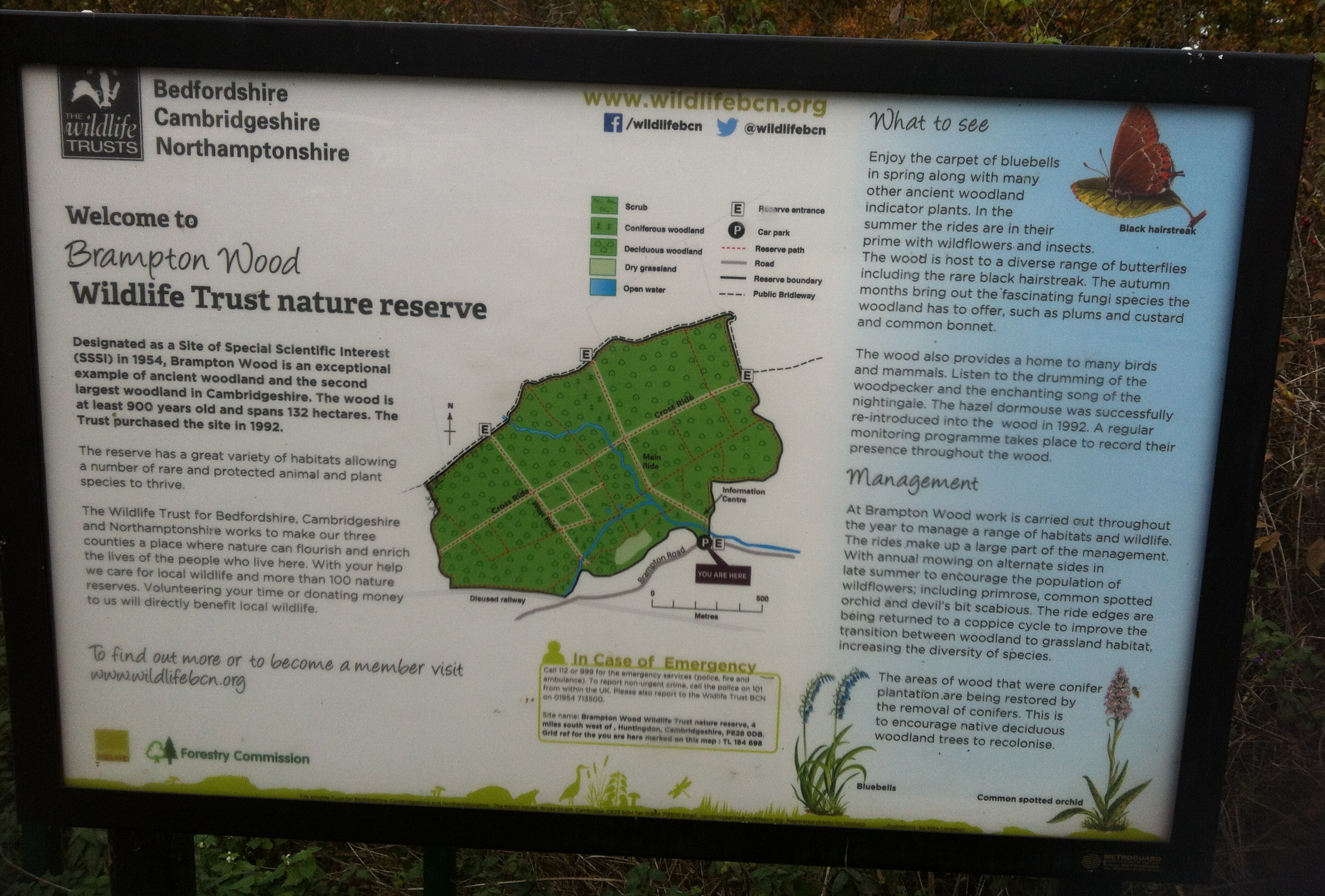
The Wildlife Trusts’ guidebook states that they have managed the wood since 1992. They bought it from the Ministry of Defence.

Guidebook:  Bedfordshire Cambridgeshire Northamptonshire guide: “Where to See Wildlife in Bedfordshire, Cambridgeshire & Northamptonshire”.

I was attending the Bolnhurst Steam Fair http://www.bolnhurstrally.org.uk/ when someone came up and sold me membership. This is not an organisation I would have thought of but I am supportive of any group that puts trees before house building.

They have a good little guide to local woods and also a website worthy of a visit: http://www.wildlifebcn.org/.

Brampton Wood has been a site of Special Scientific Interest since 1954.

But it turns out that spotting wildlife is somewhat more difficult than on some of our trips abroad.

The wood is home to dormice (which were re-introduced in 1992) but so far all we seem to have seen in our woodland visits are species of canine on and off leads.

It is the second largest woodland in Cambridgeshire at 132 hectares (327 acres). The largest is Bedford Purlieus: https://en.wikipedia.org/wiki/Bedford_Purlieus_NNR.  (Which might be the subject of a future visit/blog item).

The Wildlife Trusts organisation have a good leaflet on Brampton Wood: http://data.wildlifetrusts.org/sites/default/files/Brampton%20Wood%20Leaflet%202015.pdf.

But the wood majored less on the picturesque and more on the damp and cold the day that I went.

The guidebook states there are more than two miles of wide mown pathways and some minor pathways and follows: “pathways maybe muddy” – read will be very muddy. Take wellies (and a small tractor to drag you out).

Brampton wood appears easy to find. But where it appeared to be on the map was not where the satnav wished us to go. We went with our own judgement, and got lost. (OS Ref is TL 184 698).

If you want to find it Google indicates that it is here:

https://www.google.co.uk/maps/place/Brampton+Wood+Nature+Reserve/@52.3166644,-0.2744105,17z/data=!3m1!4b1!4m5!3m4!1s0x4877c3cb62522f8f:0x491c3106c976241c!8m2!3d52.3166644!4d-0.2722218.

Directions are: From A1, take A14 exit towards Huntingdon. Take the first exit off A14 to Brampton (B1514). Go straight at the first roundabout then right at the second roundabout. Turn right at the T-junction on to Grafham Road. Follow Grafham Road through the village and over the A1. The reserve is on the north side of the road – 1/2 mile out of Brampton. A brown sign indicates the entrance to the wood. Park in the small car park. (When they say small they are not kidding).

Following the satnav lead to a tiny left-hander off the A1. This looked to need the sort of deceleration which the Beagle Lander attempted on Mars.

As a result we took the circuitous route. This required navigation of a narrow road with enough oncoming traffic to provide diversion. After many wood-related trips we found this was typical.

Being a virgin of wood visits I anticipated a car park devoid of vehicles, our journey punctuated by some kindly gamekeeper (with a discussion of pheasant breeding practices or some such).

But turning into the most bijou of car parks I found it already well inhabited with vehicles which could have labelled modern, shiny, and family.

We squeezed in at the end of a row of these.

dsc01893

Vehicles distinguished by large rear load areas. Every one of those vehicles contained inhabitants which you could call “Rover”.(Second piece of education of the day).

All varieties of fur – caked in material which was going to need more than a small towel to remonstrate with.

Each one of the human car inhabitants turned out to have a species of cheeriness, this associated with bobble-hat, fleece, and large rangy hound.

We had snaffled the last space (or so we thought). Yet another shiny Tonka-toy-thing burbled in behind. The driver did not resort to shouting or fist-waving so I assume found somewhere to slot it.

The ground was that species of compliant which one will be familiar with if embarking-out barefoot on a wet evening and murdering a large slug in darkness with one’s toes as the offensive weapon.

Phil’s recommendation: go when it’s warmer. Although given how popular woods turn out to be with dog walkers you are always going to have a lot of company.

It is a top site for bluebells in the spring so that may well be worth a try. I wouldn’t bother with October. Unless you have a 4×4 and something large with waggy tail which doesn’t smell great when it’s wet.

Fortunately the ground was well furnished with leaves. Rainfall sufficiently far in the past that waders were not a necessity.

The Wildlife Trusts’ booklet informs me that the wood is at least 900 years old. And so had a mention in the Domesday Book.

I’m sure in the summer it is a goodly place. But the day we went it had the kind of sombre air usually reserved for death and religious buildings. (Or some combination of those).

img_4595

The link above http://www.wildlifebcn.org turns out to be the Bedfordshire, Cambridgeshire and Northamptonshire Wildlife trust – check out their website for further details.

We decided to do a circuit (starting at the noticeboards).

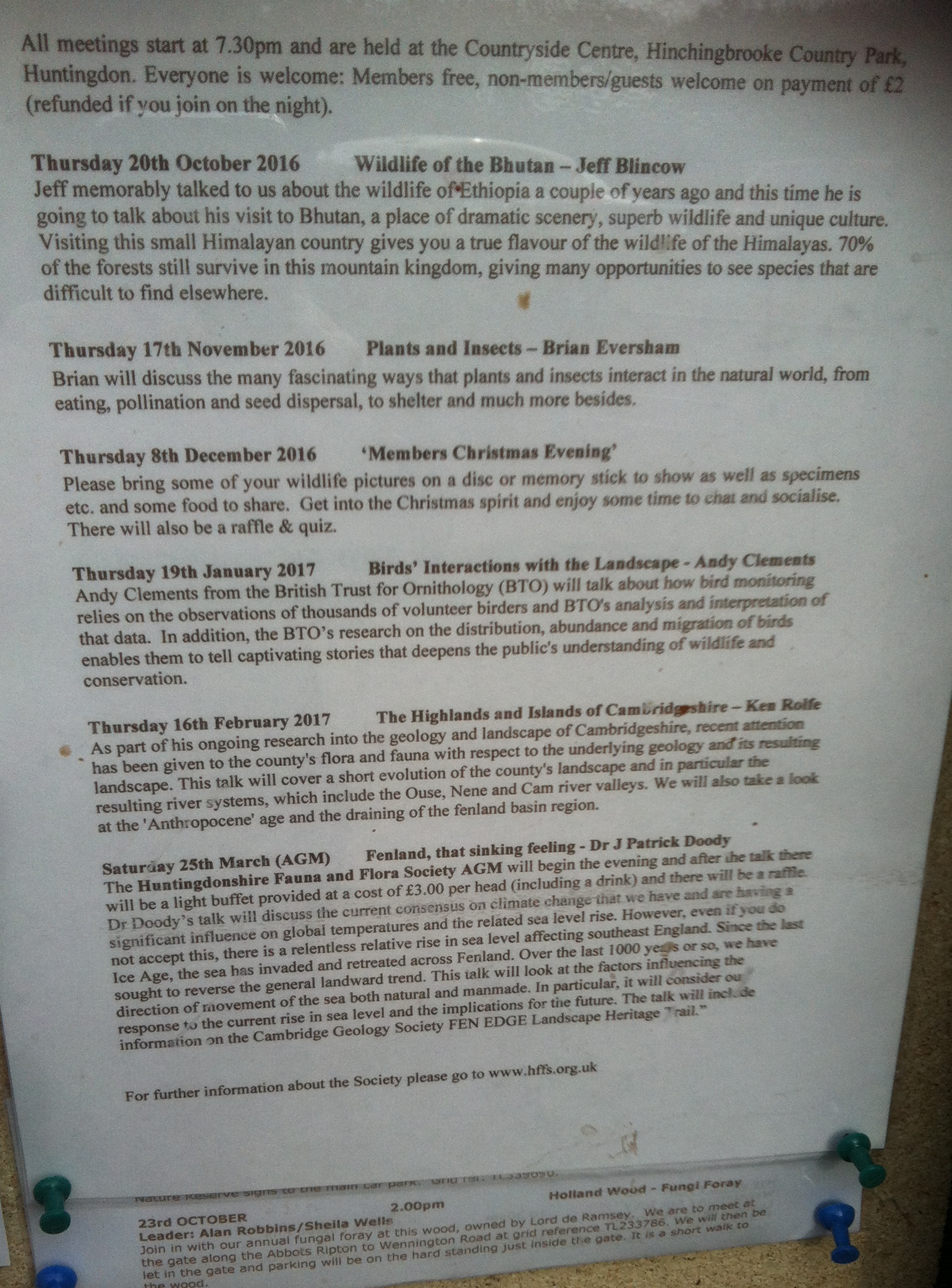
img_4594

The link above http://www.hffs.org.uk is for the Huntingdonshire Fauna and Flora Society – check out their website for further details

And so embarked on a journey around what one imagined to be the circumference – just inside the tree line.

Diverting at intervals to have privacy from the next bobble-hatted group.

In places there were stands of conifers – planted when the Government managed the wood.

These are being removed for the wood to re-establish.

img_4592

The circuit seemed too brief to me and convinced me that we must have taken the wrong route.

I’d only said good morning to 1/2 dozen people or so and I estimated the population at that time to be several times that. So where had they all gone?

After reviewing the map of the wood we realised that we had only circuited part of it. So there was a lot left to see on future visits.

A little of a good thing convinced me that more of this experience would prove more fulfilling. So decided that this wildlife idea was for me.

Gazing between the trees gave me brief memories of Borneo. It was with sadness I realised that we would see no macaque this trip. (Nor catch our clothes on any rattan).

Back to the car. The surrounding shiny and four wheel drive had swapped about a bit but not reduced in number. So lesson of wood exploration wood=popular=pooches began to form in my mind.

img_4593

Stately homes seem to be the places where frazzled adults take their small person. Woods however are where red cheeked outdoors people range about with carnivores.

Well there’s a learning point.

Brampton as we found out later was remarkable in its tidiness (i.e. no dog faeces).

Despite the car park it also proved to be unrepresentative in its lack of population. Subsequent woods were to prove much more popular.