The Apology

I can remember as a child being forced to apologise to people when I hadn’t any feelings of being sorry. In some cases I actually believed the other person was at fault.

I found that apologising has to come from within. Apologising when you do not mean it is empty and encourages feelings of revenge.

Research indicates that refusing to apologise is as beneficial as apologising. Refusing to apologise allows a person to feel more powerful and energised. The worst position is to sit on the fence and do nothing.

Some research shows that people who fail to apologise are happier than people who apologise.

In some circumstances apologising is damaging for the other person. For example if you reject someone with an apology this is more hurtful than plain rejection. The person is feeling both hurt and the need to forgive in the same moment. They need the time to process the hurt before considering forgiveness.

There are some benefits from choosing to apologise however. People prepared to apologise are viewed as more trustworthy. (Even where they apologise for things they cannot be responsible for – such as the weather).

Choosing to apologise may not be without consequences. These can range from embarrassment to admission of guilt. Admission of guilt can lead to other consequences: job loss, imprisonment, court cases and so on.

Every apology has to be considered. If you decide to apologise then at the very least you want your apology to be effective.

A recent counselling article indicates that apologies should contain the following elements:

  • Acknowledge the offense clearly – for example I did drive your car without your permission.
  • Explain it effectively – for example I waited until you went to work and took your keys from the dresser.
  • Restore the offended parties’ dignity – for example – it’s your car and I understand you will be mad that I used it.
  • Assure them they’re safe from a repeat offense. – I will not take your car again.
  • Express shame and humility – I feel very bad that I did this to you.
  • Make appropriate reparation – I will pay you for using the car and for the petrol.

Research indicates that apologies should offer assurances that the behaviour will not reoccur. They should contain sympathy for the victim. (An acceptance of responsibility coupled with a request for forgiveness).

The request for forgiveness may need to be withheld in some cases – when the victim needs time to process feelings and may not feel at all ready to forgive yet.

The timing of the apology is important. Apologising too soon may not have left the victim time to process feelings. Too late and the apology might appear to be insincere.

The key to a great apology lies in 6 key components:

  1. Expression of Regret I’m sorry I ate all the French fries
  2. Explanation of what went wrong I was hungry and ate them all
  3. Acknowledgement of responsibility It was entirely my fault
  4. Declaration of repentance I am really sorry
  5. Offer of repair I will buy you some more French fries
  6. Request for forgiveness. (However this is not applicable in every case – see text) please forgive me

These can be summarised as:

  • Tell the person how you feel I feel bad about what I have done
  • Admit the mistake and the impact of the mistake I ate the French fries and you went hungry
  • Repair the situation I’m going to buy you some more French fries

There are several examples of apologies that did not contain these key components. These have made the situation worse and/or made the victim(s) feel worse than prior to the apology.

A poor apology can lead to a desire for retribution by the victim. This could lead to a worse situation than if no apology had ever been offered.

The best apologies take into account the needs of the victim. This will require humility and empathy.


https://www.theatlantic.com/science/archive/2016/02/how-to-apologize/470457/
https://theconversation.com/the-science-of-saying-sorry-73298
http://www.independent.co.uk/news/science/the-best-way-to-apologise-discovered-science-a6982966.html
https://news.osu.edu/news/2016/04/12/effective-apology/
https://www.psychologytoday.com/articles/200207/the-power-apology
https://www.psychologytoday.com/blog/good-thinking/201304/are-you-big-enough-apologize
http://www.hbs.edu/faculty/Publication%20Files/Brooks%20Dai%20Schweitzer%202013_d2f61dc9-ec1b-485d-a815-2cf25746de50.pdf
https://www.scientificamerican.com/article/advantages-of-not-saying-you-are-sorry/
https://blog.frontiersin.org/2017/09/14/frontiers-in-psychology-sorry-apology-social-rejection/
https://www.smithsonianmag.com/smart-news/people-who-never-apologize-are-probably-happier-than-you-12584567/
https://greatergood.berkeley.edu/article/item/the_three_parts_of_an_effective_apology
https://greatergood.berkeley.edu/article/item/making_peace_through_apology
https://greatergood.berkeley.edu/article/item/how_to_make_an_apology_work


Fifty Special Things – Thanh Binh Restaurant Cambridge

When: 03-11-2016 and 10/01/2016

Where: Thanh Binh Vietnamese Restaurant, 17 Magdalene Street, Cambridge CB3 0AF, United Kingdom
Tel: 01223 362 456
Email: info@thanhbinh.co.uk/thanhbinhcambridge@gmail.com http://www.thanhbinh.co.uk/

Price: Free first time (50th birthday present), £20 second time

Review: Excellent Staff. A tiny place in which to treat yourself.

Tip: If you want to drink take your own wine – small corking charge applies.

Next in the task to have 50 great things happen in my 50th year.
See the previous account in this series:
https://magic-phil.co.uk/2017/02/12/fifty-special-things-brampton-wood/.

A suggestion from a counsellor and a great suggestion. Why does the celebration end with the birthday – why can’t it carry on all year?

One reason is making enough time available to do the things in life that you always wished to do.

The next is that, having achieved this hoary old age, remembering all the dreams that you once had becomes a lot less easy.

However I have taken this up like a new religion and so I am trying to make fifty great things happen before I am fifty one.

I think of this restaurant as being on Bridge Street. On the first visit it was a treat from my sister and had that air of specialness that comes from being the focus of attention. My sister drove me to Cambridge and I walked with her to the restaurant with the normal Phil air of complete obliviousness to geography.

On the second visit I was with people from work and I told them to meet me on Bridge Street at the bridge. Only to find the restaurant is on Magdalene Street and the meeting place was a bit beyond the restaurant. (The restaurant is up near the traffic lights and St Giles Church more than down near the Cam).

Of course people have become used by now to my species of woolly-headedness and so after some leg pulling we set off back up the hill.

The restaurant has online booking and in contrast to some places I have tried in the past it is effective. I had confirmation within a few hours of registering interest in a table for four. It is also a relief that having entrusted the booking to mouse and keyboard when I attended they were expecting me.

I had attended with my sister and brother in law for an after-50th birthday meal at the beginning of November. (I was in Borneo for my actual Fiftieth birthday. Accounts of which will be in this blog in the not too distant future). We had a great time in November.

It was with this fond memory that I had recommended it to a couple of friends from work. I was confident in the place: in that it was enjoyable; I wouldn’t have to fight my way through hordes of eager eaters, and the staff were courteous and attentive.

Importantly I would be able to find stuff for me to eat. Given I have IBS (and have a diet slightly less restricted than a vegan) this can make for some entertainment.

Details of the IBS and how it developed will no doubt hit this blog at some point as well.

Of course anything in Cambridge is going to involve some parking negotiations.
When I had come in with my sister she had driven in and very kindly paid for the parking. On that occasion we used the Park Street car park:

https://www.cambridge.gov.uk/park-street-car-park

Not what you’d call cheap, not what you’d call fragrant but had the advantage of being close. I could not recommend much in the way of parking in Cambridge. Cambridge majors on the historic or even quaint but not much on the car city. Bicycle yes, car no.

On the second occasion (taking into account that I am a cheapskate) – after arrival I drove round for some on-street parking. This left a bit of a walk down Castle Hill.

On street parking is a bit of an endangered species in Cambridge. Resident’s parking bays are apparently procreating.

Very soon parking without fee will involve the kind of expedition that would bring a gleam to the eye of Sir Ranulph Fiennes.

It is pointless recommending anywhere because as soon as this blog item is out the parking will have disappeared.

Given the distance from the venue and my encroaching portliness I was late, again.

My two friends were waiting with that patient air of someone who’d dearly like to say “where the hell have you been”. They limited themselves to mentioning that they’d decided to wait at the appointed place.

The bridge is picturesque in that tiny “I wouldn’t have noticed if you hadn’t pointed it out” kind of way. But given the outside temperatures lingering on it was likely to have been diverting for all the wrong reasons.

Despite having attended in November, by the time I attended again in January I had forgotten where it was. A fact that caused some amusement to my companions.
Although not that exceptional for me I have to say.

If you’re as far as the bridge on Bridge Street you need to retrace your steps some way towards the traffic lights. A disconcertingly long way when you can’t remember where the place.

In fact if you are opposite Magdalene College you’re just about there.
Oh and if like me you forgot to look out for it on the way down the hill and walk past it then this is a cue for more ribbing behaviour.

It is tiny.

dsc02789

I felt like I was sitting in the comfort of someone’s front room the whole time I was there.

The staff are friendly and welcoming. In that fashion which does not involve them fussing round you whilst you’re trying to have a conversation.

On each occasion it has been quiet like the low murmur of somewhere refined.

Maybe the more restricted areas of some gentleman’s club but without the wing backed chairs (and the prostitutes).

The first time we took wine to celebrate (they don’t serve wine but allow you to take your own). This is a top tip if you want to drink – they are quite happy for you to bring some.

There’s a small charge for this but cheaper than getting wine in a restaurant I thought.

The drinks available are appealing even if the lack of alcoholic ingredient may deter many.

Although Vietnamese and therefore chopsticks provided as standard fortunately cutlery is available. This is useful considering that I am a Luddite and have the finger dexterity of two large lumps of concrete.

Although chopsticks make a very effective projectile. (As I discovered; I caught one with my sleeve and sent it down to the lower ground floor level – with a resounding clatter which caught everyone’s attention).

The toilet is on the lower ground floor beside the kitchen down a winding staircase. This means having too much to drink is not too great an idea in any case (you might arrive on your backside).

dsc02790

They have both chrysanthemum tea and jasmine tea so I was a bit torn opting for jasmine through habit.

For those who can drink tea which has camellia sinensis in it they have green tea but I saw no evidence of the fermented variety.

The food is to die for and semi IBS friendly. Although I tend to find no matter how careful I am after I go out – being close to some facilities (and away from people) for 24 hours afterwards is a good thing.

The fish I had a couple of times (once on each visit) because I liked it so much. (In a former life I must have been a marine creature given my love of all things seafood).

dsc02792

Mostly you go out for the company. This is a place where you can have a conversation and not have to compete with the hubbub. Neither will you find it necessary to shrink yourself down to a skinny person – to avoid elbows, back or bum intersecting with someone else’s’ eating space.

The first occasion with family was a very uplifting experience – helped by being made a fuss of.

I can’t speak on behalf of my friends but personal view was that the second visit was also a success.

I imagine that at intervals it must become busy and I can’t speak for the experience then. Both occasions where I have attended there hasn’t been need to elbow back the crowds or to join some tiresome queue whilst you “wait to be seated”.

They have some interesting desserts too. Although after my experiences in Malaysia I would not recommend anything containing durian.

They have durian ice cream but after the face shrivelling experience of trying some on an open market in Kuala Lumpur I can’t say I was tempted this time.

The first visit I opted for the standard ice cream which given November wasn’t too shabby temperature-wise just about made sense.

January it turned out was a bit stiffer in its resolve to bring draughty. Everyone agreed dessert was not what we were looking to do.

If you’re coming in and do not fancy car park negotiation one of my companions pointed out that Shire Hall is now pay and display at £1 per hour (at weekends). Compared to some multi storeys this is a disgraceful bargain. But if you’re a cheapskate could be considered ruinous. Consider it a contribution to the good works of the local authority…

I recommend this restaurant for a visit. I’m hoping that my recommendation will not ruin the special atmosphere through increased demand.
Perhaps the thing is to get in quick before the rush starts.

Fifty Special Things – Brampton Wood

When: 30-10-2016

Where: Brampton Wood http://www.visiteastofengland.com/Huntingdon-Brampton-Wood/details/?dms=3&venue=0211398

Price: Free

Review: Not at its best in October; go when it’s warmer

Tip: follow the satnav in this case it makes a better job of finding it.

Brampton wood and the start of many wood visits.

Communing with nature is restorative: http://www.yesmagazine.org/planet/we-know-nature-makes-us-happier-now-science-says-it-makes-us-kinder-too-20160312.

So to start with this appeared to be a great choice.

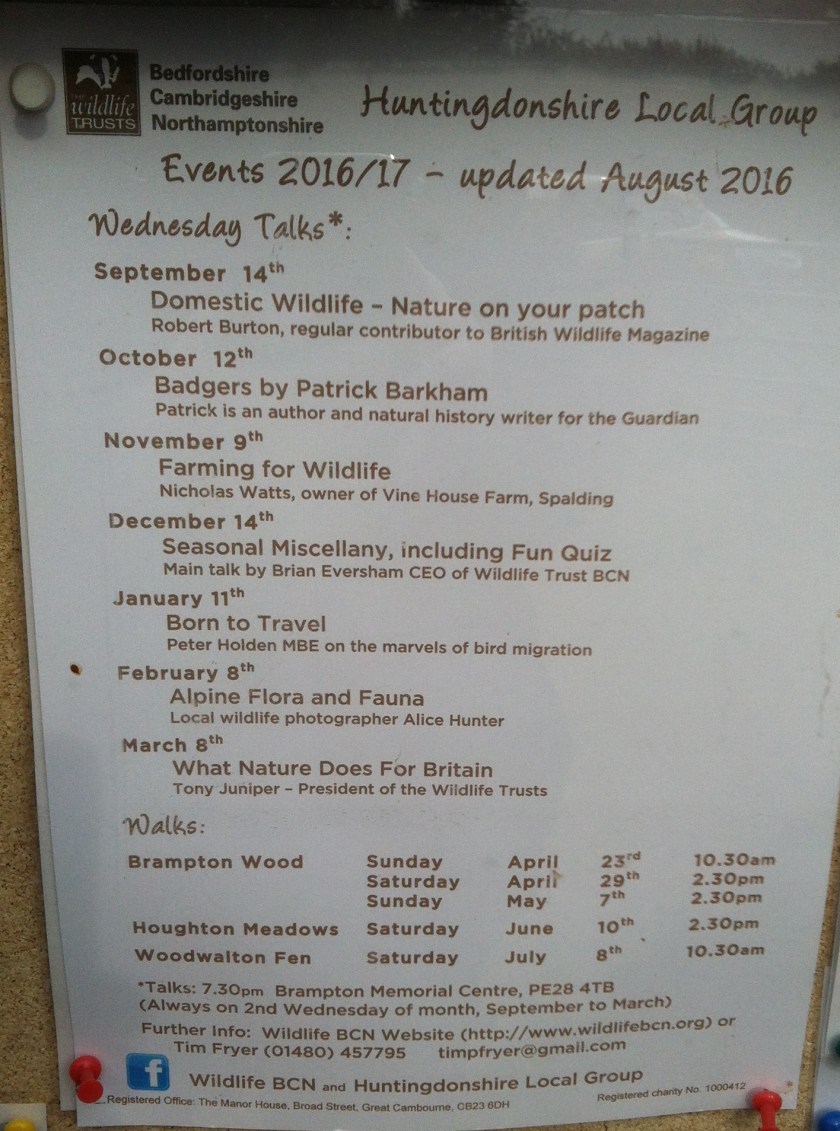
The Wildlife Trusts’ guidebook states that they have managed the wood since 1992. They bought it from the Ministry of Defence.

Guidebook:  Bedfordshire Cambridgeshire Northamptonshire guide: “Where to See Wildlife in Bedfordshire, Cambridgeshire & Northamptonshire”.

I was attending the Bolnhurst Steam Fair http://www.bolnhurstrally.org.uk/ when someone came up and sold me membership. This is not an organisation I would have thought of but I am supportive of any group that puts trees before house building.

They have a good little guide to local woods and also a website worthy of a visit: http://www.wildlifebcn.org/.

Brampton Wood has been a site of Special Scientific Interest since 1954.

But it turns out that spotting wildlife is somewhat more difficult than on some of our trips abroad.

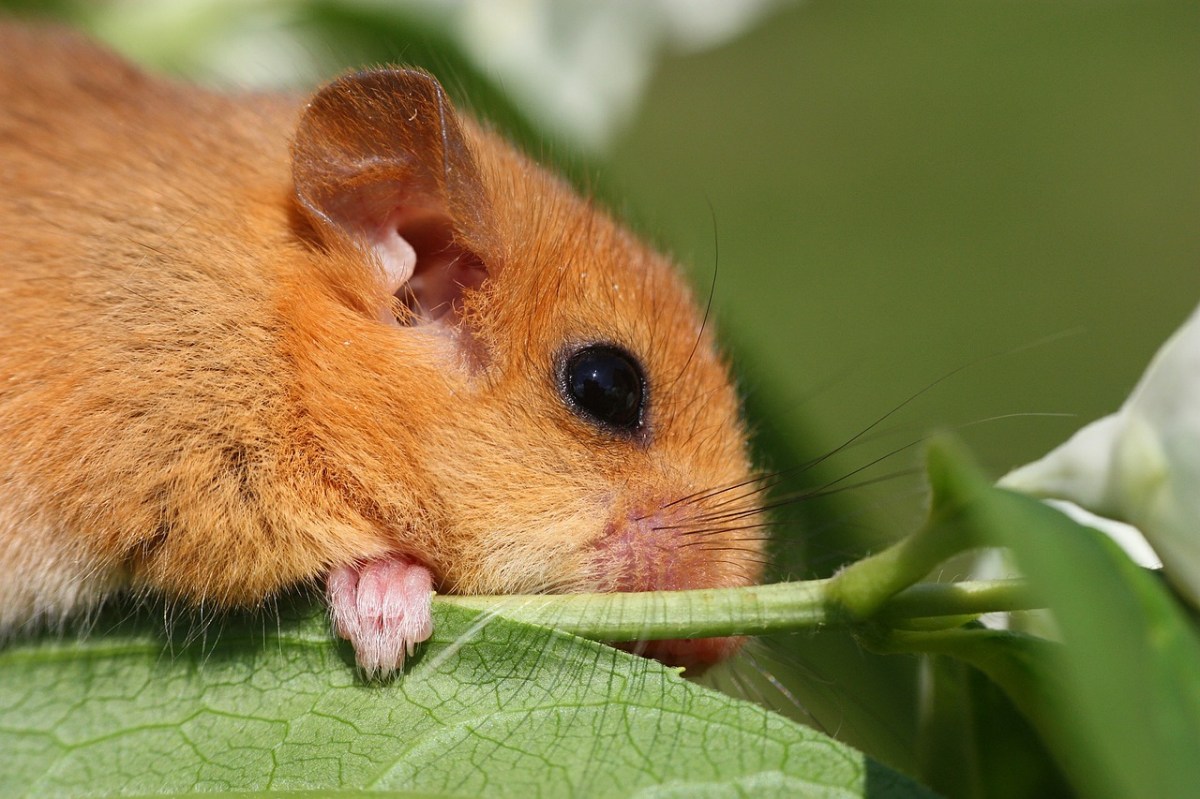
The wood is home to dormice (which were re-introduced in 1992) but so far all we seem to have seen in our woodland visits are species of canine on and off leads.

It is the second largest woodland in Cambridgeshire at 132 hectares (327 acres). The largest is Bedford Purlieus: https://en.wikipedia.org/wiki/Bedford_Purlieus_NNR.  (Which might be the subject of a future visit/blog item).

The Wildlife Trusts organisation have a good leaflet on Brampton Wood: http://data.wildlifetrusts.org/sites/default/files/Brampton%20Wood%20Leaflet%202015.pdf.

But the wood majored less on the picturesque and more on the damp and cold the day that I went.

The guidebook states there are more than two miles of wide mown pathways and some minor pathways and follows: “pathways maybe muddy” – read will be very muddy. Take wellies (and a small tractor to drag you out).

Brampton wood appears easy to find. But where it appeared to be on the map was not where the satnav wished us to go. We went with our own judgement, and got lost. (OS Ref is TL 184 698).

If you want to find it Google indicates that it is here:

https://www.google.co.uk/maps/place/Brampton+Wood+Nature+Reserve/@52.3166644,-0.2744105,17z/data=!3m1!4b1!4m5!3m4!1s0x4877c3cb62522f8f:0x491c3106c976241c!8m2!3d52.3166644!4d-0.2722218.

Directions are: From A1, take A14 exit towards Huntingdon. Take the first exit off A14 to Brampton (B1514). Go straight at the first roundabout then right at the second roundabout. Turn right at the T-junction on to Grafham Road. Follow Grafham Road through the village and over the A1. The reserve is on the north side of the road – 1/2 mile out of Brampton. A brown sign indicates the entrance to the wood. Park in the small car park. (When they say small they are not kidding).

Following the satnav lead to a tiny left-hander off the A1. This looked to need the sort of deceleration which the Beagle Lander attempted on Mars.

As a result we took the circuitous route. This required navigation of a narrow road with enough oncoming traffic to provide diversion. After many wood-related trips we found this was typical.

Being a virgin of wood visits I anticipated a car park devoid of vehicles, our journey punctuated by some kindly gamekeeper (with a discussion of pheasant breeding practices or some such).

But turning into the most bijou of car parks I found it already well inhabited with vehicles which could have labelled modern, shiny, and family.

We squeezed in at the end of a row of these.

dsc01893

Vehicles distinguished by large rear load areas. Every one of those vehicles contained inhabitants which you could call “Rover”.(Second piece of education of the day).

All varieties of fur – caked in material which was going to need more than a small towel to remonstrate with.

Each one of the human car inhabitants turned out to have a species of cheeriness, this associated with bobble-hat, fleece, and large rangy hound.

We had snaffled the last space (or so we thought). Yet another shiny Tonka-toy-thing burbled in behind. The driver did not resort to shouting or fist-waving so I assume found somewhere to slot it.

The ground was that species of compliant which one will be familiar with if embarking-out barefoot on a wet evening and murdering a large slug in darkness with one’s toes as the offensive weapon.

Phil’s recommendation: go when it’s warmer. Although given how popular woods turn out to be with dog walkers you are always going to have a lot of company.

It is a top site for bluebells in the spring so that may well be worth a try. I wouldn’t bother with October. Unless you have a 4×4 and something large with waggy tail which doesn’t smell great when it’s wet.

Fortunately the ground was well furnished with leaves. Rainfall sufficiently far in the past that waders were not a necessity.

The Wildlife Trusts’ booklet informs me that the wood is at least 900 years old. And so had a mention in the Domesday Book.

I’m sure in the summer it is a goodly place. But the day we went it had the kind of sombre air usually reserved for death and religious buildings. (Or some combination of those).

img_4595

The link above http://www.wildlifebcn.org turns out to be the Bedfordshire, Cambridgeshire and Northamptonshire Wildlife trust – check out their website for further details.

We decided to do a circuit (starting at the noticeboards).

img_4594

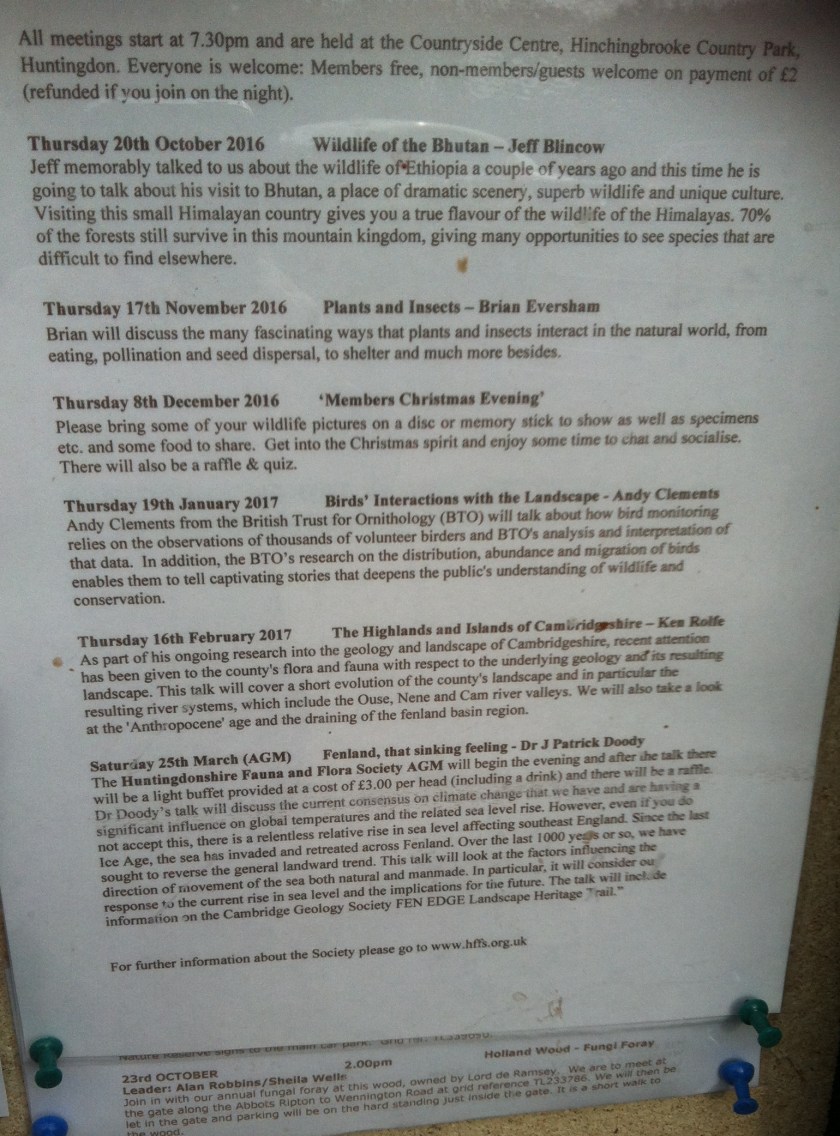
The link above http://www.hffs.org.uk is for the Huntingdonshire Fauna and Flora Society – check out their website for further details

And so embarked on a journey around what one imagined to be the circumference – just inside the tree line.

Diverting at intervals to have privacy from the next bobble-hatted group.

In places there were stands of conifers – planted when the Government managed the wood.

These are being removed for the wood to re-establish.

img_4592

The circuit seemed too brief to me and convinced me that we must have taken the wrong route.

I’d only said good morning to 1/2 dozen people or so and I estimated the population at that time to be several times that. So where had they all gone?

After reviewing the map of the wood we realised that we had only circuited part of it. So there was a lot left to see on future visits.

A little of a good thing convinced me that more of this experience would prove more fulfilling. So decided that this wildlife idea was for me.

Gazing between the trees gave me brief memories of Borneo. It was with sadness I realised that we would see no macaque this trip. (Nor catch our clothes on any rattan).

Back to the car. The surrounding shiny and four wheel drive had swapped about a bit but not reduced in number. So lesson of wood exploration wood=popular=pooches began to form in my mind.

img_4593

Stately homes seem to be the places where frazzled adults take their small person. Woods however are where red cheeked outdoors people range about with carnivores.

Well there’s a learning point.

Brampton as we found out later was remarkable in its tidiness (i.e. no dog faeces).

Despite the car park it also proved to be unrepresentative in its lack of population. Subsequent woods were to prove much more popular.

Restarting Your Life

This week I was sent an inspirational video.

It stood out because of the parallels between the way this method suggests you manage challenge, and counselling practices I have observed.

Sadly for me the whole thing falls down through its focus on people of greatest ability; I think this is a mistake.

These people are certainly the highest earners and therefore unsurprisingly the focus of an enterprise like Thrive Labs http://www.thrivelabs.co/ which Priya Parker is running.

Elitism over life-changing advice ensures that Priya’s business gets to pay the bills but the very brightest are only going to be a percentage in any population.

If we said for example only those with a PhD it turns out to be about 1 in 500 people (https://www.quora.com/What-is-the-percentage-of-the-worlds-population-who-hold-doctorate-degrees).

That would leave 499 out of every 500 people who are not benefiting from this technique.

For every Einstein there are hundreds that made sure he had roads to drive on, bread for his sandwiches, and cotton for his shirts.

This needlessly restricts the audience for such advice. Given this is very like a standard CBT technique which is designed to work for everyone.

When I saw this video I thought about the aspects of its message that involved challenge.

Important and creative parts of the counselling process involve challenge.

Counselling homework involves facing your true self and your fictions.

Challenge is key to making positive change.

Priya indicates self-challenge is critical in leading a life you will be happy to look back on in later years. Her strap line is “quit your life and reboot”.

The video had no associated transcript: you may want the edited highlights rather than the entire talk.

These are the highlights that stood out for me:

  • People hate their jobs. They apply themselves and work hard but they stay because they are afraid to leave.
  • People would like to make better life choices.
  • The anxieties of the “brightest” is a public problem.

Everyone has fears I wonder what those who are not thought of as the “brightest” are to do about them?

There are various methods to address these anxieties. These methods also attempt to identify need in the world and recruit people to address that need.

There are different levels of need in the world: whilst one man’s challenge is to resolve drought in sub-Saharan Africa, another man may content himself with fixing the neighbour’s car.

1. The Obituary Test

Imagine that your death is being announced. Write your own obituary.

(Presumably you are not allowed to use latitude here. For example I would probably start out “Phil was a bang up chap who everyone loved…”)

The aim is to drive out how you would like to have lived

(I’m guessing this does not allow for: “like Ozzy Osbourne”).

2. The Passion Comic Strip

A number of people believe that they have no passions. This method will help you to identify your passion.

Interview five to ten people who know you well. Ask them when it was that they saw you look most alive. (Think Wallace meets Wensleydale.)

(I wonder if all such moments would be suitable for sharing?)

Draw a comic strip:

The reason you use drawing here is that:

  1. Drawing utilises a different part of the brain to writing. (This seems to assume that you have the capacity to draw.)
  2. Images are more powerful than words. (In what way images are more powerful is not described.)
  3. Most people’s drawing skill is rubbish so you will not be able to take yourself too seriously once you have seen the resulting comic strip. (Again a valid counselling technique.)

3. Get Comfortable With Discomfort

This strikes me as like CBT in terms of challenge which indicates that almost anyone could participate in this activity.

Quitting life is scary hence you need to develop “discomfort muscles”.

(You will still feel the fear but you also need to be able to manage it).

  1. In a queue (say at a supermarket checkout) start singing – keep singing even when you can feel your heart pounding.
  2. Take yourself to dinner alone AND take no reading material. Take no phone. Do not make any excuses. Book it; turn up; eat a full dinner alone with nothing to distract you from your discomfort.
  3. The backward elevator test. Walk in to an elevator, face the back. Keep facing the back even as everyone in the elevator gets uncomfortable.(What prevents people dragging you off to certain institutions, thumping you or reporting you to law enforcement agencies is not detailed in this video.)

4. Give Yourself a Life Sentence

Critical questions:

  1. What do I value?
  2. What is my purpose?
  3. What do I want to be?

There are three parts to a life sentence:

  1. What are the qualities or values I want to bring with me?
  2. What is it that I actually do?
    (Given you’re on The Procrastination Pen this might be a valid question).
  3. To what end? (Why do you do this)?

This is regarded as the hardest of the methods but it is the most effective. It needs a large commitment of time. Generally with someone who knows you well.

Once completed this is useful as a filter – everything in life will take you closer or further away from your life sentence.

If it is part of the life sentence you do more of it. If it falls outside the life sentence you do less or stop doing it altogether.

5. Dwindling Cash Experiment

How do you know how much is enough money for you?

Not merely how much do you need to live but how much do you need to feel comfortable?

The test is to understand what it is like to live on different incomes by experiencing those incomes.

Sit down and calculate how much money you spend in a month. Take out this sum. Hold it in an envelope (say under the mattress)
.
(Given I work in security this sounds needlessly scary why not store it in the safe instead.)

Week 1 – take out 40% of the amount you withdrew; spend it on what you like.

Week 2 – take out 30% of that original figure and spend it.

Week 3 – take out 20% of the original figure.

Week 4 – take out 10%. (This assumes a four week month).

So if the total amount is £5000 a month.

In week one you have £2000 to spend.

In week two £1500.

In week three £1000.

In week four £500.

The lack of knowledge about how much money is enough creates fear. This enables you to work out how much is enough for you.

(£1 ½ million monthly would do me nicely.)

6. Help Somebody Else

Work out which five of your friends do interesting work.

(Assuming that you have five friends).

Spend an hour with them problem solving their stickiest problem.

This assumes you are capable of solving this problem –perhaps for the purposes of this the attempt is sufficient.

This is beneficial because:

– It creates a habit of “how can I help” – a habit which is helpful to society. It has also been established that helping others is good for your well-being as well.

http://greatergood.berkeley.edu/article/item/can_helping_others_help_you_find_meaning_in_life

– It helps you to find the problems that you care about – these are the ones for you to focus on.

– It shows what you are good at solving.

7. Set a Withdrawal Date

Send evites for a farewell party (this is a real thing; evites are electronic invites).

Personally this just sounds like “getting down with the kids” – I’m sure that paper invites, cards or telephone conversations would do as well.

Include seven of your closest friends.

(Assuming that you have seven friends).

This makes you accountable to a peer group – the assumption being it is much harder to back out once you have completed this stage.

Conclusion

Stepping back from your life allows you to see it clearly (a pretty key step in any counselling) and is also key in being able to change it.

Problems require talent to work on them and to solve them.

The part that doesn’t work for me is that only the brightest can benefit from this practice.

I would counter that you can skill up all kinds of people to resolve existing problems.

Thinking about meaning is scary. However fear should not deter you (another key counselling concept).

Change requires: time, space and risk (which is also why counselling can take time).

Thinking about what matters to you, what makes you come alive and then dive in.

This will make a difference to society, yes, but in my view, more importantly, it will make a difference to you.

Things You Really Will be Doing Now You’re 50 – Part Five

Following on from part four of the things you are going to find when you’re 50.

https://magic-phil.co.uk/2016/12/11/things-you-really-will-be-doing-now-youre-50-part-four

Ten more items from the same list:

  1. You can’t see road signs so you get glasses. You can’t see to thread a needle, so you get glasses. Any task involves juggling eyesight correcting devices. You develop a facility for recognising different varieties of fuzzy as objects.
  2. Just as you get to like something you find that the shops stop stocking it. Years ago you just moved on. Now you find yourself scanning auction sites, second hand stores, junk shops in the hope of continuing to use that thing you have a fondness for.
  3. Suddenly everything in the past seems more pleasant than today. You forget the shoddy brakes on your first car and wish you still had it. You forget the unpleasantness with the neighbour and consider that everyone was much friendlier then. Constant rain showers are dispelled in memories of long summers of unbroken sunshine. You have entered the nostalgia zone.
  4. After a long time of dismissing it as boring you find an hour of Gardeners’ World quite relaxing. You get drawn in. Before long you find that you are making way too many visits to garden centres. Eventually you start listening to Gardeners’ question time…
  5. You meet up with some friends that you haven’t seen in a long time. You know that you haven’t changed but you are shocked at how old they look…
  6. In conversation someone remarks that you have a lot less time to go than you have already had. After the message has had time to sink in you realise that actually you don’t mind about that. You wonder if that means there is something wrong with you.
  7. Whitening your teeth sounds a great idea. Surely this would improve your appeal to other people. However you realise that your mouth now contains more amalgam than tooth.
  8. Snoring will start to punctuate your night time hours. You will find no explanation for this. In order to avoid being murdered by your partner you take to the sofa.
  9. Your body formerly lived a halcyon existence of cooperative equanimity. Now the disparate parts engage in a war with one another. If one area is dry an adjacent area is greasy. If one is jittery due to inactivity another is tired out from exercise. Whilst one feels fit another feels damaged. Every action is punctuated with either fatigue, itching or little stabs of pain; apparently to remind you that this dispute is underway.
  10. Other people have now moved you from a position where you might have been appealing to some kind of universal parent figure. Your role is now to listen and support; to give advice (which they will ignore). This enables them to go on with their lives; in which it is never suspected you could be involved.

That’s the 50 things that will happen to you now that you are 50, I’d welcome any comments (unless of the trolling variety. If you like this blog please subscribe by email and you will get updates as I post new stuff.
If you missed part one you will find it here:
https://magic-phil.co.uk/2016/12/11/things-you-really-will-be-doing-now-youre-50
If you missed part two you will find it here:
https://magic-phil.co.uk/2016/12/11/things-you-really-will-be-doing-now-youre-50-part-two
If you missed part three you will find it here:
https://magic-phil.co.uk/2016/12/11/things-you-really-will-be-doing-now-youre-50-part-three
If you missed part four you will find it here:
https://magic-phil.co.uk/2016/12/11/things-you-really-will-be-doing-now-youre-50-part-four

That’s it for this series.

Things You Really Will be Doing Now You’re 50

Articles on how to live your life abound; instructions on this; guidelines on that.

If the first 5 decades seem to have been chaotic it might appear that consulting this guidance may provide some hope of enlightenment.

It was in light of this that I stumbled across this article which gives suggestions about what you can do now that you have reached 50:
https://www.onefamily.com/hub/wellbeing/50-things-to-do-now-youre-50

All very well but for me this article did not reflect being 50 in any real sense.

Here are the steps that you will inevitably encounter when you’re 50.

Tradition dictates that there should be 50 of these, but 10 is all I’m prepared to read at one sitting.

  1. Alcohol: moderate drinking leaves you with a hangover which would’ve taxed Gandhi. More than moderate drinking has you escorted to a hospice. Drinking over more than one day means a trip to an expensive rehab centre.
  2. You will forget the name of someone you’ve known for at least ten years; you’ll be too embarrassed to admit it. Months later you’ll be trying to remember where you put your keys; for no obvious reason the name will pop back into your head.
  3. A malicious poltergeist will move into your house. It will confine itself to moving your keys, your money, your work’s access pass. You will spend the start of most journeys hunting for one or more of these items.
  4. You will develop an irresistible urge to sleep whenever you sit down – any comfortable surface will find you drooling into your collar: park benches, train seats, brambles, nettles.
  5. You’re on better terms with the doctor than you have been your whole life; your medical records are being moved to The National Archives.
  6. You meet some people from school and find at least one person you knew is already dead and has been for some time. You start guessing which of you will be next.
  7. Without warning you develop a fondness for cardigans, they become your default outer wear.
  8. Saga starts to send you junk mail – for some reason their trips start to look interesting.
  9. Room temperature of 20 oC seems to be like the inside of a Greenland glacier; you keep revisiting the thermostat.
  10. The heroes you’ve had in your life now turn out to be paedophiles or dead or more often both.

Instalment two in this series covers the next 10:
https://magic-phil.co.uk/2016/12/11/things-you-really-will-be-doing-now-youre-50-part-two

Things You Really Will be Doing Now You’re 50 – Part Three

Following on from part two of the things you are going to find when you’re 50.

https://magic-phil.co.uk/2016/12/11/things-you-really-will-be-doing-now-youre-50-part-two

Ten more items from the same list:

  1. For a long time you have prided yourself on how laid-back you are. Not for you excitement over the miners’ strike, Milli Vanilli, or the Falkland’s war. Recently you are getting red-faced; yelling at the television like some Alf Garnett caricature. You start to avoid certain national newspapers and Question Time on the BBC.
  2. You’ve crammed as much into your life as you thought possible; considered that every moment was a busy moment. Now juggling has become more frenetic. You consider ways to do more: reading whilst going to the loo; learning whilst sleeping; writing your memoirs whilst stood on one foot pulling on a sock. You wonder whether sleep should be optional.
  3. Posters, brochures, TV adverts you notice are predominantly in favour of young people. You’ve never noticed this before. “Young people are our future”; “young people deserve a chance”; “think of the children”. You’ve been excluded from important people in society and no one gave you any warning.
  4. Skimpy underwear for young people is exciting, no underwear is considered provocative. For some reason now big underwear is appealing; if it doesn’t reach your belly-button you no longer consider buying it.
  5. Gatherings of people seem to generate enough noise to rival a Motörhead concert. You find yourself avoiding socialising; instead sitting in to watch repeats of familiar programmes.
  6. People now find it a great idea to deny how old you are. “You’re 50; you don’t look it”; “I never would have thought that you were 50”; “50? You look much younger”. Even though you know that it’s fabricated, you still like it and work to pretend it is genuine.
  7. There are gaps in your hearing – tones that you can no longer hear. You attend hearing tests and no one can detect these gaps. Oh there’s hearing loss but that’s “normal” for your age. People you like start to use those tones to communicate. “What?” is now a conversational feature.
  8. Despite appearances, as far as you’re concerned you are still 18. You feel 18. You’re sure you think like 18. If only your knee would stop hurting you’d give that snowboarding a try. Other people see you as some hoary old hermit. This is confusing. For some reason you’re no longer allowed to go rock climbing, roller blading or clubbing and you’re unable to understand why.
  9. Things that happened yesterday as far as you’re concerned: the music of your youth; the attitudes of your teen years; the clothes people chose. These are now referred to as “classic” or “old school”. Those times are regarded as morally the Wild West. Those who lived through them are regarded with suspicion; as borderline depraved.
  10. You’ve ceased to be described by absolutes. When you were younger you might have been “good at maths”; “good at running” or, if you were very lucky “good” with the opposite sex. Now “for your age” becomes a universal qualifier “your vision isn’t bad for your age”; “your blood pressure is good for your age” or if you’re very lucky “you look good for your age”. You’ve lost the ability to be just “good” at anything and have joined a group of people older than 50 who must therefore be less “good” than everybody else.

If you missed part one you will find it here:
https://magic-phil.co.uk/2016/12/11/things-you-really-will-be-doing-now-youre-50
If you missed part two you will find it here:
https://magic-phil.co.uk/2016/12/11/things-you-really-will-be-doing-now-youre-50-part-two

Watch out for part four here:
https://magic-phil.co.uk/2016/12/11/things-you-really-will-be-doing-now-youre-50-part-four