Book Planning

Planning a novel should follow the monomyth.

The character is boring unless they are also wrestling with conflict. The conflict should have a purpose – the character returning to life transformed by it. To maintain interest conflict should start early in the book.

When working out your book plan – planning around 20 chapters is a good average to start with. The plan should include the basic plot which you then use to write the book from.

In previous blog posts we have considered the seven basic plots https://magic-phil.co.uk/2018/01/23/seven-basic-plots/ and the framework of the novel https://magic-phil.co.uk/2018/02/06/the-framework-of-a-novel/. So we have covered the monomyth and the seven basic plots already.

Choose which of the seven basic plots you would like to plan and work out your plot.

“Work out your plot” sounds a bit too easy. So it proves – these are some questions I asked about my attempt from the writing course:

Plot Questions

Start with the premise of someone who will not/cannot adapt to society.

In what way can they not adapt?

(Work, rules, joy, happiness, communication, memory, interest, importance, holiday)

Perhaps they have a sense of isolation –a self-constructed cell that has no walls but which permits no escape.

What kind of a world should it be? Not too different to this one.

It sounds like an illness – what kind of obscure illness should it be?

What are the sanctions to this person? Where/who do the sanctions come from?

Why do they have to hide?

What if people find out about them? (Will they be concerned? Will they betray them?)

What do they do if they still don’t adapt?

What kind of lack of adaptation would cause complete shunning of them by the rest of society?

Where can you run when the whole world is owned? What if the effort to own is too much? Where can you go with that? What if the competition is too much?

As you can see working out the plot causes many questions. I only had time to list some on the course but the longer that you spend the more questions you will have. I also think that having lots of questions will fill better fill out the plot and lead to more interesting characters.

Start of the Plot

Given the above preparation I arrived at this as the start of a plot:

At the age of nine comes selection. Thomas had always regarded himself as different and shuddered now in the line.

He saw the days before as carefree. Days in which games and laughter as much filled the playrooms as the careful instruction to comply, to serve, to address the ills that an unregulated and unconforming world could only bring.

Thomas has been raised like all children (since a time that no one alive would now remember) in a crèche away from interference and distraction. Loved and managed by Nana who’s warm smoothness had sheltered them when babies. At night time she ushered them to sleep as they grew.

Nana was the kindest machine Thomas had so far encountered and he loved her as he loved no one living.

Thomas had never felt the same about the others, those his own age with which he shared a nursery, sleeping, eating, playing. To Thomas they were all different, something he always kept closely to himself. Thomas never wanted to fit, he didn’t want to be selected, but when he told Nana this she had dismissed it. Everyone had to be conditioned – why wasn’t he more like his crèche mates.

He had learned to speak no more of it.

He had wondered if he was special and in darker moments if his parents had been criminals – the few for whom conditioning would not take.

The future – after nine – had sounded so dead, without play, without Nana…

The other children were so happy that they would be allowed 21 days a year to go to the sun, to sit on beaches with other conditioned people. They were happy to fit a normal life, performing their function.

Thomas couldn’t imagine any future could be worse – all of life given to a function, no more games, no more Nana.

With the selection he would be one of many allocated to a discipline for which he was best suited. His brain activity analysed, his aptitudes scanned and evaluated, it would not take long – Nana said it wouldn’t hurt.

So far Thomas had to agree, it was boring, staring at the back of someone’s head. He was wishing in that he would not get taken inside, they’d forget somehow, that he wouldn’t have to serve.

The selection booth seemed quiet, apart from a muted background hum. Thomas didn’t feel happiness, didn’t feel peace. This chamber felt like a threat to him. He felt fear trembling in his legs and thudding with rapid repetition in his chest.

The door behind him closed, there now seemed no way back – only forwards.

He slid to the ground and began to cry, would he have to work? Would he never be able to run around Nana screaming with happiness?

As he sat the helmet levitated from the inner room – the place where he was to arrive – but he had resisted. It passed unseen overhead as he huddled inside the door and descended onto his bowed head. With a puff of anaesthetic the electrodes engaged.

Thomas was conscious of the analysis but felt no need to attempt to dislodge the device. His body now lifted and set in a chair. Electrodes strapped over him reading wishes, desires, aptitudes.

Somewhere behind it all was Thomas. He wanted to avoid allocation, to be without work, to run outside again, free.

The machine reading the purpose for which he was best suited. It engaged the first stage of programming – coercing the mind into a path which was most suitable.

It hadn’t taken long. Thomas emerged now. A technician – training downloaded, programming embedded. He was ready for a contented life in service, keen to embark on a lengthy apprenticeship to fulfil his true purpose.

Machines are not perfect. The design of the programming helmet is to smooth neural pathways. It is to direct the growth of learning and to remove old memories. In fact to remove anything that would hinder the future happiness of those who came within its attention.

Outwardly Thomas was now a keen young technician destined as he was for 10 years of training, acclimatization and conditioning. Life much easier than ever before: regular breaks, true holidays and downtime. He was programmed to meet those which similar machines had designated appropriate. With some of whom Thomas could produce future generations of adapted technicians.

The machine though had missed something. One of the thinking traits was out of the ordinary. Thomas’ great faith that he did not fit had produced a self-fulfilling circuit…

Thomas had the neural seeds of discontent sowed within him.

Outwardly the smiling face of just another happy employee but in fact gradually that seed would grow, and each night emerge in dreaming.

The Thomas not in technician’s uniform. The Thomas not working at all, running along a rainswept shore. The Thomas unlimited by 21 days of annual leave; the designated holiday-destinations in approved-hotels. The hotels where Thomas would meet with those who reaffirmed the importance of a technician’s life.

How vital it was that he put in those 39 hours a week monitoring, maintaining, fabricating.

Hidden to those around him, Thomas’ growing awareness that this life was not for him.


This is just the intro to the process which might give you a few pointers but as you can see there is quite a bit more to it.


If you liked this article why not follow this blog

Follow The Procrastination Pen on WordPress.com


Photo by Bich  Tran from Pexels https://www.pexels.com/photo/mountain-illustration-669987/

The Framework of a Novel

Outline plans (the framework) come in different shapes and sizes dependent upon your preference. Guidance indicates that spending a great deal of time on an outline plan is worthwhile in preparation for writing.

On one of the writing courses I attended there was an introduction to producing an outline plan. However the approach taken would be scratching the surface. The depth of your own plan would almost certainly be much more extensive than achieved here. But it might give some pointers to people who want to do an outline plan themselves.

This was an outline plan produced for a novel on one of the writing courses I attended. I haven’t done anything with it subsequently but it might give some insight into the start of the process. I would then spend much longer understanding the outline before diving in and commencing to write. Your Mileage May Vary.

Taken from the seven basic plots https://magic-phil.co.uk/2018/01/23/seven-basic-plots/. This outline is based on the idea of the quest which has this basic structure:

  1. The call
  2. The journey (archetypal figures)
  3. Arrival and frustration
  4. Final ordeal and last battle
  5. The goal, treasure, prince/ess

The plot can have as many subplots as you like. Subplots are similar in theme but do not have to be the same as the plot.

Every character that you choose to include will be overcoming something as part of their progress in the book.

Subplots can be resolved part of the way through the book.

Each character will have a subplot and this tends to result in a large novel.

The average novel is 75,000 words but there are some that are over 100,000 words.

When planning a novel this should be along monomyth lines.

(Joseph Campbell Bookfinder

the hero)

The Monomyth

The single story through which we understand all stories (Joseph Campbell)

  1. Hero in ordinary world
  2. Call to adventure
  3. Reluctance to accept call
  4. Encouraged my mentor
  5. Crosses the threshold
  6. Enters the special world
  7. Encounter tests, allies and enemies
  8. Cross another threshold: inner most cave
  9. Endure big ordeal
  10. Takes reward
  11. Flees back down the road
  12. Cross 3rd threshold – resurrection/transformation
  13. Return with elixir – a treasure to benefit the ordinary world


My outline plan to reflect this was:

  1. A 9 year old boy has to be selected for a future life and to be configured for the best fit for that life.The configuration is also constraining in that once configured realistically that is the only life that he could expect to lead from that point onwards.However he feels himself to be unique. He starts to fight the selection process.He would like to escape configuration and have a life outside the constraints of the normal rules.
  1. The boy is taken for configuration anyway and is unable to escape. Configuration is successful and he enters an apprenticeship willingly.One of the aspects of configuration is that it also ensures compliance with expectations around for example occupation and behaviours.He leaves behind his child life and aspirations. He forgets his desire for a life which is different to other people his age. He departs his home and we next see him in training.
  1. The initial frustrations with existence have subtly altered the mental pathways in his mind. This is unknown to him. Overtly the configuration has taken successfully. But over time he finds himself increasingly unable to adapt to expectations.He becomes increasingly concerned that his behaviour will be detected.He has seen others who have failed configuration disappear. Those who disappear are not seen subsequently.
  1. Eventually the problems of configuration are detected in him. However the delay has given him time to prepare.He runs.There is a running battle.Ultimately he escapes from the training zone into an area of “misconfigured” people.

    Although the mental configuration will not take in these people an alternative strategy is employed.

    These people are physically adapted which means that they still fit the social norm.

    Through subterfuge he is able to exist in this area of the “misconfigured”.

    He determines that members of “the misconfigured” have no value.

    They are not monitored – they are disposable.

    After a great deal of time with them he starts to learn something of the configuration process.

    Eventually he amasses sufficient expertise to reprogram some of “the misconfigured” who have so far managed to survive.

    In doing so he causes their deaths.

    However he is able to use their deaths to completely escape the training programme.

  1. This means that he has to go on the run again.Because “the misconfigured” have no value the deaths are not investigated. This means that he is able to obtain the freedom from constraint that he dreamed of when a child.However he gains this freedom at the cost of guilt for those he has killed.Outside of the training zone resources are in short supply and his survival is impacted due to the absence of food, skills and other resources.

If you liked this article why not follow this blog
Follow The Procrastination Pen on WordPress.com

Beginnings pt. 3 – Beginning at the End

Photo by Dom J from Pexels https://www.pexels.com/photo/notebook-writing-pencil-start-45718/

This beginning seems the opposite of what is expected – the first paragraph of the story begins where the story ends. The rest of the story is then leading up to this point.

For the author the advantages include knowing exactly where the story will end up and so carrying that clarity through the rest of the story.

It is often said that an effective beginning cannot exist without knowledge of what the end will be. In this situation the writer creates both in the same paragraph.

For the reader it can build an intriguing atmosphere which causes them to want to read on (if done well).

However if you deliver too much with the beginning there will be little cause to read on. An insufficiently fascinating end/beginning may cause the story to hit the bin.

This is further to my earlier blog posts on beginnings:

https://magic-phil.co.uk/2018/01/02/beginnings/

and

https://magic-phil.co.uk/2018/01/09/beginnings-pt2/

I have been relaying some of the items I learned from writing courses about the options available for beginnings of stories.

All of these are story beginnings which I have created for different writing courses so they are not examples of perfection.

When creating these beginnings I focused on one character “Dave the Effective Detective” and I got quite fond of him.

However if there is a story for him I do not appear to be the man to bring it forth. So this is all we are likely to know about him.

Beginning at the End

A fly buzzes around the lamp.  The lamp still lit in the middle of the day but no one will switch it off.  On the bed, the long cool body darkens in the heat and the missing space that once held an accountant’s brain is now sprayed upon the wall.

If you liked this article why not follow this blog

Follow The Procrastination Pen on WordPress.com


Seven Basic Plots

From another writing course the idea that there are just seven basic writing plots.

(Originally Christopher Booker – 2004 Bookfinder seven plots)

I am not clear how valuable it is knowing that there are seven basic plots. I imagine that you are trying to write something unique and new.

If you see “Award Winning Writer” in your future I cannot imagine you getting there by following a pre-prescribed route.

However it might be useful to see what has gone before – here are the seven basic plots.

Overcoming the Monster (e.g. The Hobbit, Cloverfield, Dracula, Harry Potter)

    1. Anticipation and call
    2. Dream stage – thinks overcoming will be easy
    3. Frustration – face to face with monster
    4. Nightmare stage – final ordeal
    5. The thrilling escape from death and death on monster

Rags to Riches (e.g. Jane Eyre, Great Expectations)

    1. Initial wretchedness at home and call
    2. get out into world – initial success
    3. The central crisis
    4. Independence and the final ordeal
    5. Final union, completion and fulfilment

The Quest (e.g. Lord of the Rings, The Hobbit)

    1. The call
    2. The journey (archetypal figures)
    3. Arrival and frustration
    4. Final ordeal and last battle
    5. The goal, treasure, prince/ess

Voyage and return (e.g. Sinbad, Alice in Wonderland, Peter Pan, James and the Giant Peach)

    1. The fall into another world (ie. Alice in Wonderland)
    2. Initial fascination – dream stage
    3. Frustration stage – dark shadow figure
    4. Nightmare stage – its dominating looks like dark force will win
    5. Thrilling escape and return to normal world

Comedy (e.g. Hitchikers Guide to the Galaxy, Witches Abroad)

    1. Shadow of uncertainty and confusion
    2. Confusion get worse – disguise men/women
    3. Confusion gets resolved and lives happily ever after

Tragedy (e.g. The Martian Chronicles)

    1. Anticipation stage
    2. Dream stage
    3. Frustration
    4. Nightmare
    5. Destruction

Rebirth (e.g. Jonathan Livingston Seagull)

    1. Hero is cursed by dark power
    2. Dream stage – talk of a curse
    3. Curse takes hold and imprisons the hero
    4. Nightmare stage – no way out, no hope until hero turns up and relies someone else to save the day
    5. Miraculous redemption


Free Writing

A technique which appears to come up rather often. Variously termed free writing, timed exercises, stream of consciousness writing and so on.

Some people practice this as a distinct form of writing, which I had not considered as an option for example:

https://ashortconversation.com/about/

Both writing and counselling use this technique. (It is likely it is used elsewhere as it is so useful).

When used as part of counselling automatic writing is about whatever comes to mind. The idea being that this may access thoughts which are otherwise hidden.

It may also be used as part of a mindfulness practice.  Writing tends to slow the thoughts and enable a person to observe their own thinking. This practice may make it easier to manage that thinking going forwards.

Expressive writing involves an allotment of time (say 20 minutes). In this time a person writes down their thoughts about a challenging aspect of their life. The writing should fully explore how they have been affected by it. The idea being that it helps the person to deal with the situation.

Evidence suggests it is effective for example in conditions like anxiety.

It is also used for assisting clients to deal with difficult situations from their past.

From the perspective of the author this is a time set aside for writing practice without preconceptions or plan. It is designed to assist in bringing out ideas. It can be used to try to help a writer become unstuck.

The very act of getting words on paper can bring out solutions to problems that you have been wrestling with.

There may be as many ways of attempting this as there articles about it.

I have this approach from one of the writing courses that I attended. It is as effective as any other method:

Decide in advance how long you would like to give the exercise and set a timer (smartphones do this very well).

Ten minutes, twenty minutes up to an hour are usual amounts of time. This is dependent upon how long you believe you can sustain the activity. (It might be easier to start with shorter amounts of time and build up as you get familiar with the process).

Once you have allocated the time, you have to write for the whole time. The main rule is that you do not stop, get up or in any other way interrupt the practice once you have started.

Observe certain rules to get the most out of the exercise.

  1. There is no pausing once you begin. No reading what is already written. No stalling or gazing out of the window.
  2. There is no editing during the process. No crossing out, punctuating, substituting words or similar.
  3. Even if something is obviously wrong do not remove it. This includes things you did not expect/intend to write, poor spelling, punctuation or grammar. The writing can be as scrappy as you like including failing to respect ruled lines or margins.
  4. Pretend you have no control over what you are writing – this may help you be more creative.
  5. There should be no time for thinking – disengage brain and write.
  6. If the writing turns out to be scary too self-exposing (or in any other way taking risks you’re unhappy with) go with it anyway. The idea is to use this energy.

The aim is to get to your truest writing self. This is where you no longer censor yourself but write what you are truly feeling and thinking.

Here are some of the exercises I completed on my course. I never worked out the characters any further than this so I doubt they will appear anywhere else:

Exercise

And I have found that the majority of people that I meet have skills which I have no experience of. I have no idea how they learned or why I didn’t.

I do not see that things that a person wears. I do not remember the look in their eyes, detect the tone in their voice. I do not remember that yesterday their hair was grey and today it is boot black.

The truth is that I do not detect the importance of these things. I am not clear that the investment of effort and of time yields the results that others, gleaming eyes, inform me of.

I believe that it causes a great darkness of gossip and inward looking. I am not clear that the knitting psychological effects do not offset this. I cannot be clear unless I develop the skill.

But this part of the brain is missing. I think now only of events of changes and of developments. Identifying things, items and moments has always been far easier more diverting. I have to relate that I find it impossible now to invest any energy in the skills that I do not have.

I am a parody of a person. Now an actor in which the outer shell is a charming soul who listens, perceives, comments and applauds. Internally I am mechanical. A whirring set of gears designated to achieve only the outcomes which I have selected important. A manipulator content for others to smile whilst I manoeuvre into a position that takes me where I wish to go.

And yet oiled and tuned as the machine has become I remain thwarted unsuccessful limited. I reflect upon those skills and wonder if the outer signs are not subtly detected. The dark inner facets of my soul displayed to those I seek to charm.

Exercise 2

Awareness, working and silence. Dark with the dull red gleam of the alarm clock humming oldly beside the bed. Then again a twitch and the bed shudders like the dying spasms of a large fat animal.

Damn 2:15am again. Pain across the eyes. The struggle upright and look at the ground. Vacant greyness as the cogs start to whirr. Carpet focusing and defocusing until finally he accepts – awake again.

Shuffling silent descending and mumbling through the early rituals 2 ½ hours early

No steadiness, no rest, no silence. At last angry at accumulated sleeplessness. He sits TV sound off and allows a vacancy to permeate his brain. Waiting for the drum drum announcement of heating water which informs him at last that day can officially begin. The routine scramble for leaving can finally take over.

The greyness now seems inside as well as out. Each action harder, each thought more tenuous. Minor accidents now creating great depths of anger disproportionate to their effect.

The heavy needles of warm water serve only to remind of sleep opportunity lost and long day to come.

Regret no less than annoyance – why no sleep again.

The journey is too difficult too trying. Each vehicle a personal slight on him. Too slow; too fast; too hesitant. An excuse for overheated annoyance to swelling bombasity.

Watch that. Quell it. Have control. Slip quietly back. Slow. Watch yourself. Quietly does it

The heavy mist lays down around the park. Silent trudging marks the finals stages of the journey. Miserable damp sticky. A wait for the self-important guard to release the security door. At last he reaches the place of all his concerns. Wheezing the final steps till he makes an arrival.

Exercise 3

Your careers teacher tells appalling lies. “There is nothing that you cannot do”; “Aim High”; “The World is your oyster”.

Pretty soon you determine that you can’t depend on your careers teacher unless you already know what to do.

You turn up and stare blankly at one another. Until, in desperation, you come up with a random idea. Which he/she sets to with relish as if it were part of some life plan for you.

Of course you may follow this through in the absence of any better idea. But beware if you hadn’t an idea beforehand. Following someone else’s idea is even worse.

Your parents will become amateur careers advisors the moment that they recognise the fix that you are in.

Be wary.

This is lies too.

Formed from good intentions no doubt. But of absolutely no use to you. “You need a trade” “it doesn’t matter what you do just do it well” “we’re proud of you whatever”.

This is not helpful.

Lastly do not pay attention to any of your friends. “Working in this job is easy”. “Why don’t you try what I do I hardly ever put in a full day’s work”. “I started in April and already they’ve given me a pay rise”.

Utter tosh.

You will find the truth yourself. Many aspects of that truth will cause you to resent those lies. It will cause you to doubt advice from that point onwards.

You are correct to question that advice. Indeed any advice. For what other person has any idea of how you think, believe, react.

http://skepdic.com/autowrite.html

https://ggia.berkeley.edu/practice/expressive_writing

https://www.mindful.org/a-writing-practice-for-those-who-like-to-keep-doing/

http://www.counselling-directory.org.uk/counsellor-articles/writing-as-therapy-a-silence-that-speaks-louder-than-words

https://psychcentral.com/blog/the-power-of-writing-3-types-of-therapeutic-writing/

https://www.psychologytoday.com/blog/sideways-view/201308/writing-therapy

Beginnings pt2

Further to the earlier blog post on beginnings:

https://magic-phil.co.uk/2018/01/02/beginnings/

From different courses I have some practice exercises for beginnings.

The beginning is important to any writing so I thought this was useful to share.

This time a more popular beginning than the last.

Bear in mind that these beginnings have received healthy criticism in their time.

There are different styles of beginning the previous one was “Third Person Objective.” this one is the “First Person Main Character” beginning.

In this the main character narrates the story and will be the “I” in the text.

The first person main character is one of the most commonly used points of view.

It allows the reader to have empathy with the character as they see the world through their eyes.

Because you control the point of view you can lead the reader in a direction that you choose.

You can make them feel that they are participating or even mislead (and surprise them).

It is also easier on the author who can work with one point of view only.

Unfortunately it brings the same restrictions as a single point of view in any walk of life. You can only see through one character’s eyes. You limit yourself to their perspective (which might be biased or unreliable).

Elements that occur outside of that character’s awareness are more difficult to introduce into the story.

These beginnings will all involve my favourite character at the time of writing “Dave the Effective Detective”.

I’ve never thought of a story in which he belongs. Condemning him to appear only in these beginnings.

The First Person Main Character Beginning

“I shouldn’t have done it, oh no I shouldn’t have done. Oh, they will lock me up me up now and I’ll lose everything.

The house will go and the car and I’ll be alone and I can’t deal with being alone and where will I be then.

Oh no I shouldn’t have done it” “Yes I should, I should have done it. I shouldn’t have failed, stupid Dave, can’t even work out how to kill himself. Dave the fool, Dave the idiot. Stupid, stupid, how hard can it be Dave?

A car, a hose, a running engine, Dave, eh?”

“You’re just worthless; you knew you were, worthless oh you should never have tried it.”

In my mind, amongst the voices declaring my worthlessness, a calm and quiet voice was whispering “get a hold of yourself Dave; hold it together Dave; come on Dave you can do it.” A voice now drowned by the babble of self-accusatory tones. I can’t face Belinda; she got me here of course.

I can’t move – I can’t face the space outside that door.

Outside that door now seems so threatening it feels like a doorway to a world I no longer know, I don’t belong there.

I know that I soiled myself in the night, but I feel nothing, I do nothing. I can’t feel anything; I just listen to the voices in my head again.

“Useless Dave, hopeless Dave”

Photo Credit: robert_oosthuizen Flickr via Compfight cc

Character

Over time I have attended various courses on writing.

These have not had any lasting effect on my ability to actually write anything.

As an after-effect of these different efforts I have various short pieces of work with no home to go to.

I can’t see that any of these will be the foundation of some best seller.

I am gambling that displaying your old work has no deleterious effects on future writing.

On that assumption I will put them out there warts and all.

On the basis that it is possible someone might get some small pleasure from reading them.

From some old writing exercise I have this short piece of writing that did not make the grade.

The idea was to describe a character. But the feedback was that the character was one-dimensional.

In fact the reflection was that he was a little shit and that this made the end satisfying to read.

I was very sympathetic to Mike and I quite liked him. In some aspects I felt an affinity with him. So it is sad that he did not make the grade as a character.

Anger

Mike gripped the Momo steering wheel, his knuckles pale. Petite hands, not like a man’s at all, slender wrists and puny forearms, which are currently in tension. So that the slim muscles are clear.

His acne scarred face reddened with aggression.

Mike barks out “Move you bastard!”

He weaves his lowered Vauxhall Nova towards the right-hand side.

The darkened purple interior vibrates in time to a huge subwoofer behind his left ear – “50 Cent”. Mike adjusts the baseball cap forwards a little and leans forwards. His nose inches from the screen; he revs his engine with a whoosh of the dump valve.

The ash from his fag is forming a scree slope down the front of his T-shirt. His clothes are market-stall “designer”; all sportswear accented with gold jewellery from Argos. Today Mike wants to look cool.

Finally, he has passed his test at the ripe old age of 18, old for a license. He would have to tell them he passed months ago. They couldn’t know he was a new car virgin.

He’d had to be nice to his god-awful parents for a whole week now. He’d finally persuaded his dad to give him the money for this real bitching car. He could tell them it was all his own work – they’d think he was cool then.

His face ape-like in concentration screwed up. With ears stuck out at right angles beneath his close-shaven hair.

He looks for even a minute gap in the traffic “Fuckin’ Wankin’ Granddad, why not fuck off and die”

He edges his lurid green front spoiler close to the boot in front and flashes the four-way headlights. His laceless trainers describe a dance on the “custom” pedals until the unbalanced car slews sideways.

He leers, “Hope that scared the old bastard!”

He wanted to arrive like a star in “2 Fast 2 Furious” in a rush, lights blazing. He wanted to impress (particularly Roz – she looked great in that pink mini skirt last week). But this idiot was holding him up. He felt his heart beat faster – he wanted to kill him in a serious way. He could imagine ripping out his still beating heart. Kicking the gagging corpse around until this feeling ran cold.

He hit the horn hard and then zigzagged out until he was parallel, nothing would stop him now.

What was this? The old guy was accelerating, fucker, he would have him. Mike plants the accelerator hard into the purple carpet. He feels the blood pumping past his calf muscle as he exerts great pressure to keep it there.

Sweat springs from his forehead as he looks ahead at the oncoming bend.

He won’t give way; this git will never take him. Every muscle in his 5’ 7” frame taut he grits his teeth. He will win this or die, the evil fucker.

The Speedo needle crawls upwards, the corner, not past yet, he won’t brake, never. He turns to give the guy the finger as the Volvo truck rounds the bend.

Using Online Tools to Improve Your Writing Pt 2

After Part 1:

https://magic-phil.co.uk/2017/01/23/using-online-tools-to-improve-your-writing/

We are still embarking upon the journey of testing out editing tools based upon the article:

http://nybookeditors.com/2016/02/instantly-improve-your-writing-with-these-11-editing-tools/.

Part one concerned AfterTheDeadline and did not exactly blow my pants off.

This time we are looking at Autocrit. Health warning the NYBookEditors article describes this as a pay for option and if there is no free trial option then I will not be exploring it. (On the basis of being a lifelong cheapskate).

The location is https://www.autocrit.com. (https reassures my IT Security bones – I’m feeling better about this option already).

In addition on browsing to the page I find that it states that you can paste in some text for free

Autocrit page

For those who did not read the last post:

https://magic-phil.co.uk/2017/01/23/using-online-tools-to-improve-your-writing/.

Here is the text that I am analysing – filled with errors which several people have pointed out.

He stopped the car at the style gate.  The handbrake was still a bit dodgy; he gave it a hefty pull and said a silent prayer that it wouldn’t run away down hill.

The “Great Park” spread out before them – old stained post and rail fencing, long grass, the occasional tree dotted randomly.  Zones of poor drainage where the marsh marigold was already showing saffron flower heads.  He felt his heart quicken just slightly – he hadn’t done this sort of thing for years.

Mandy was here for the “rare mushroom” or that’s how he thought of it.  Mandy had tried patiently to remind him that it was a fungus.

“Russula Pseudo-affinis” his ticket to pleasure land.  This boring little brown-capped fungus had only been seen in one other place in the UK.  Derek had found it surprisingly easy to convince her that he had seen some sprouting in the corner of the Great Park.

It’s amazing what a night spent with G.J Keizer’s “Encyclopaedia of Fungi” can result in.

A keen mycologist like Mandy Briggs couldn’t resist, he’d offered to drive, pretended he was as interested as she in the damn mushrooms.

Mandy – she was tall, bookish and appeared totally plain, no one ever saw Mandy in male company.

Derek knew something they didn’t.  It was Mandy’s love of lose pullovers; they hid her body so well no one knew the joy beneath.  That and that lengthy awful brown skirt, the one that was always heavily stained from studying the ink caps and wax caps on hands and knees.

Hands and knees, yes that’s how he’d seen her, examining a “White Spindle” fungus beside the car park; that over large pullover and the absence of underwear – a revelation.

He determined to introduce Mandy to the delights of male company as quickly as he could bring it about and he had no scruples about the use of subterfuge.

He steadied Mandy as she stepped over the style, gaining a glimpse of shapely calf as she did so, this was better and better.

Down the grassy slope, slipping and sliding in the dew-heavy grass his leather shoes unsuited to the terrain; the grass here a darker shade from the constant dampness.  At the base of the slope a tiny copse, mainly ash and hawthorn but with the occasional oak tree.

He had planned for the “use of” a drier area beneath one stately member – it would be ideal for his carnal destiny – a blanket was too obvious for this “field trip”.

She was braced against a tree – back to him.  This would be too easy.

She turned as he approached to indicate a spiny coral fungus.  The contour of that bum beneath the plain cotton so wonderful; he reached forward to run his fingers lightly down the obvious parting of those two cheeks.

The impact was sudden, violent.  He couldn’t believe the pain.  He’d thought it a lie – it surely couldn’t be this painful?  He folded like an emptying balloon cradling his soreness.

I’m hopeful if we keep the text the same that this gives the editing software chance to do its job. In addition it enables accurate comparison between the effectiveness of the tools.

Initially pasting the above into Autocrit caused the entire page to freeze completely (At least in Microsoft Edge). So I killed it and started again.

I tried again but the page didn’t even acknowledge that I had entered text – assume something to do with my choice of browser.

So start again using Internet Explorer.

Sure enough the tool kicked into touch and clicking analyse text took me to a page that asked for my email address (I have a throwaway email address for just such a purpose and I recommend that you do the same).

Once you complete the process it appears that you can keep going back to the same page and select from each of the options available, which are:

options available

However a quick review of the output reveals that it is the same in each case so it is not clear why the options are offered.

(Potentially it is a way to target the marketing of the solution to you via the email address that you supplied – you did use a disposable address didn’t you?)

This is the output that I received:

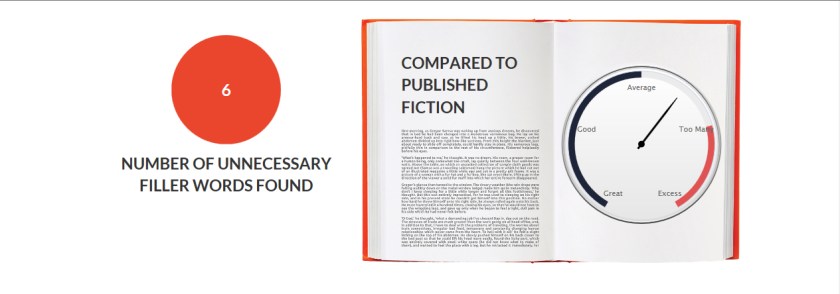
results 1

results 3

results 4

results 5

results 7

results 8

results 9

results 10

results 11

results 12

Sadly the free version of the report does not actually point out where in the text the problems occur. So it is a case of looking carefully at the text using the prompts given and attempting to identify areas that need work.

This gave me this as an output:

He stopped the car at the style gate.  The handbrake was still a bit dodgy; he gave it a hefty pull and said a silent prayer that it wouldn’t run away downhill.

The “Great Park” spread out before them – old stained post-and-rail fencing, long grass; the occasional tree dotted randomly; zones of poor drainage where the marsh marigold was already showing saffron flower heads.

He felt his heart quicken just slightly. He hadn’t done this sort of thing for years.

Mandy was here for the “rare mushroom”. That’s how he thought of it.  Mandy had tried to remind him it was a fungus.

“Russula Pseudo-affinis” his ticket to pleasure land.  This boring little brown-capped fungus had only been seen in one other place in the UK.  Derek had found it surprisingly easy to convince her he had seen some sprouting in the corner of the Great Park.

It’s amazing what a night spent with G.J Keizer’s “Encyclopaedia of Fungi” can result in.

A keen mycologist like Mandy Briggs couldn’t resist, he’d offered to drive, pretended he was as interested as she in the damn mushrooms.

Mandy – she was tall, bookish and appeared totally plain, no one ever saw Mandy in male company.

Derek knew something they didn’t.  It was Mandy’s love of lose pullovers; they hid her body so well no one knew the joy beneath.  That and the lengthy awful brown skirt the one that was always heavily stained from studying the ink caps on hands and knees.

Hands and knees, yes that’s how he’d seen her, examining a “White Spindle” fungus beside the car park, the over-large pullover and the absence of underwear – a revelation.

He determined to introduce Mandy to the delights of male company as quickly as he could bring it about and he had no scruples about the use of subterfuge.

He steadied Mandy as she stepped over the style, gaining a glimpse of shapely calf as she did so, this was better and better.

Down the grassy slope, slipping and sliding in the dew-heavy grass his leather shoes unsuited to the terrain.

The grass here a darker shade from the constant dampness. At the base of the slope a tiny copse, mainly ash and hawthorn but with the occasional oak tree.

He had planned for the use of a drier area beneath one stately member. It would be ideal for his carnal destiny – a blanket was too obvious for this field trip.

She was braced against a tree – back to him.  This would be too easy.

She turned as he approached to indicate a spiny coral fungus.  The contour of her bum beneath the plain cotton so wonderful; he reached forward to run his fingers lightly down the obvious parting of those two cheeks.

The impact was sudden, violent.  He couldn’t believe the pain.  He’d thought it a lie – it surely couldn’t be this painful?  He folded like an emptying balloon cradling his soreness.


I am not an editor (that is why I was using a tool) and so this is not going to be sufficient for what I need.

No doubt the paid for version of AutoCrit is ideal in this respect, certainly the feedback is much more detailed than with the After the Deadline tool I evaluated last time.

https://magic-phil.co.uk/2017/01/23/using-online-tools-to-improve-your-writing/

Next time CorrectEnglish:

Gravatar

For some time now I have found my blog decorated with something that detracted from the look of the site.

When I create blog pages I see this in the blog page:

Gravatar

This seemed to me a waste of space and I wanted to get this removed from the page.

I made an enquiry with WordPress technical support.

The feedback was that this was part of the theme design and only a custom design (at some cost) would get rid of it.

On setting up the site I spent a disproportionate amount of time selecting the “theme” (which for me is 2016).

Having spent a long time with the theme choice; I was not keen on a redesign or for the cost of having a custom design done.

If I was stuck with this – could I make better use of it than I have done to date?

It turns out that the icon is a placeholder for a Gravatar:

https://codex.wordpress.org/How_to_Use_Gravatars_in_WordPress.

Gravatar is a Globally Recognised Avatar. Wherever you make a posting an icon will appear identifying that posting as belonging to you.

Given my posting history consists of one blog; this is overkill. But I have an icon on my page which I need to do something about.

The above article states that WordPress.com allows access to the Avatar through the settings part of the site:

site

In fact I access by clicking on the tiny icon at the top of the page:

icon-stroke

Selecting this enables access to my profile and to change my Public ID and picture:

Profile

I reasoned that if I was going to do this then I should put some things about me as well:

my details

After which my blog site now appears like this:

icon-concluded


EXIF

People share their location, by uploading images to the Internet, and in most cases do not know they are doing so.

For example, “I know where your cat lives”: http://www.independent.co.uk/life-style/gadgets-and-tech/news/i-know-where-your-cat-lives-feline-photo-mapping-website-exposes-how-easy-it-is-to-track-the-owners-a6743621.html

And:

https://motherboard.vice.com/en_us/article/vvb7yx/this-guy-is-cyberstalking-the-worlds-cats-in-the-name-of-privacy.

Every image taken with a modern camera (or smartphone) has embedded in it the location where it was taken.

If you take a photograph in your garden – tools on the Internet can reveal where your house is:

https://www.pic2map.com/.

For other data that is embedded in photos read this:

http://www.makeuseof.com/tag/3-ways-to-remove-exif-metadata-from-photos-and-why-you-might-want-to/.

Wherever possible I like to recommend tools that are free or low cost.

One of my favoured image editors is a tool called GIMP:

https://www.gimp.org/.

This is both free and open source (all the code used to write GIMP is freely available).

The Gimp interface currently looks like this:

Gimp Interface

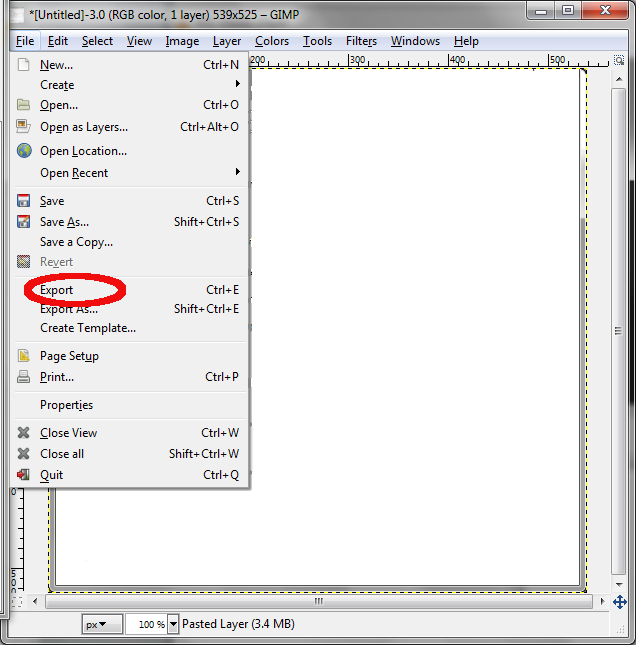
If I take a screen shot (an image with no embedded metadata), paste this into GIMP and select File – Export:

Export

Give the file a name:

name-file

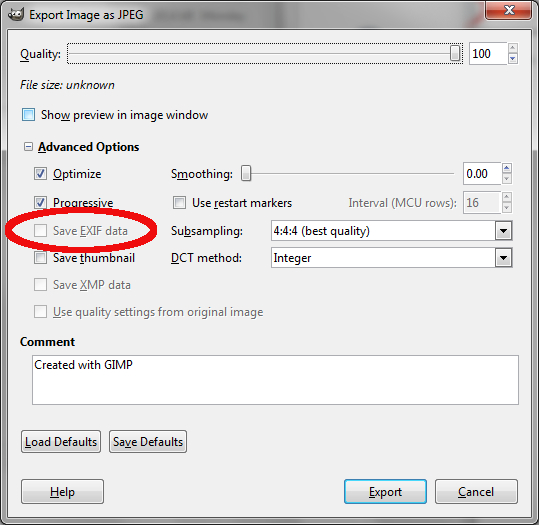
Click Export (the name of the file determines which options you see here – I will show the options for JPEG).

advanced options

Expand Advanced Options.

save EXIF data Gray

The “Save EXIF Data” option is greyed out (the screenshot contains no EXIF data).

However, if I open a photograph with GIMP and follow the above steps, the “Advanced Options” looks like this:

save EXIF Data normal

The “save EXIF data” option is available (this is because the image contains EXIF data).

To remove the EXIF data from an image before uploading it to the Internet, follow the above steps. (Ensure that you export the image with a different name to that which the camera gave it by default – to avoid overwriting that original image).

Take the tick out of the “Save EXIF data” box as pictured above and click the Export button.

Your image now contains no information that can be used to identify you or your camera. The image is therefore safe to upload to the Internet.

There are of course alternative methods of removing EXIF data. This article details some of those:

https://www.howtogeek.com/203592/what-is-exif-data-and-how-to-remove-it/